
TAVR Surgery Cost in India: TAVI Price, Procedure & Recovery
TAVR/TAVI valve price, hospital charges, tests, recovery and what a package should include — with a free personalised estimate within 48 hours.
Top Hospitals
for TAVR / TAVI
Find hospitals with structural-heart teams, advanced cardiac imaging, dedicated cardiac ICUs and transparent itemised packages.
Explore Hospitals →Top Cardiologists
for Aortic Valve Disease
Connect with cardiologists and cardiac surgeons experienced in aortic stenosis, transcatheter valve procedures and surgical valve replacement.
Find Specialists →Direct answer: TAVR surgery cost in India generally ranges from ₹18 lakh to ₹35 lakh ($18,750–$36,460), although complex cases may cost ₹38 lakh ($39,585) or more. TAVR, also called TAVI, replaces a diseased aortic valve using a catheter rather than conventional open-heart surgery. The final cost depends on the artificial valve, hospital, medical condition, investigations and postoperative care.
| Treatment Information | Details |
|---|---|
| Procedure | Transcatheter aortic valve replacement (TAVR), also called TAVI |
| Purpose | Replace a severely narrowed aortic valve (aortic stenosis) using a catheter-delivered valve |
| Alternatives | Surgical Aortic Valve Replacement, medical management for selected patients |
| Related Treatments | Heart Valve Replacement, Mitral Valve Replacement, Heart Valve Repair |
| Pre-Procedure Tests | Echocardiography, CT scan, ECG, blood tests, coronary assessment |
| Performed By | Cardiologist & Structural-Heart Team |
TAVR Surgery Cost in India: Quick Overview
Transcatheter aortic valve replacement (TAVR) is a specialised procedure used primarily to treat selected patients with severe aortic stenosis. The replacement valve is delivered through a catheter and positioned inside the diseased aortic valve. Unlike conventional surgical aortic valve replacement, TAVR usually does not require opening the chest and removing the old valve through open-heart surgery.
| TAVR/TAVI cost component | Approx. USD | Approximate cost in India |
|---|---|---|
| Complete TAVR/TAVI treatment episode | $18,750–$36,460 | ₹18–35 lakh |
| Complex TAVR treatment | $31,250–$39,585+ | ₹30–38 lakh or more |
| Transcatheter valve device alone | $15,625–$26,040 | ₹15–25 lakh, depending on device |
| Pre-procedure investigations | $1,040–$2,085 | ₹1–2 lakh |
| Catheter laboratory and procedure charges | $5,210–$8,335 | ₹5–8 lakh |
| ICU and hospital care | $2,085–$4,165 | ₹2–4 lakh |
Apollo Hospitals publishes a TAVR cost range of ₹21 lakh–₹35 lakh, while Medicover Hospitals publishes approximately ₹18 lakh–₹30 lakh (see Reference Links below). Individual estimates vary by hospital and treatment plan. If you are comparing valve procedures, see our guides to heart valve replacement cost and mitral valve repair cost.
What Is TAVR or TAVI Surgery?
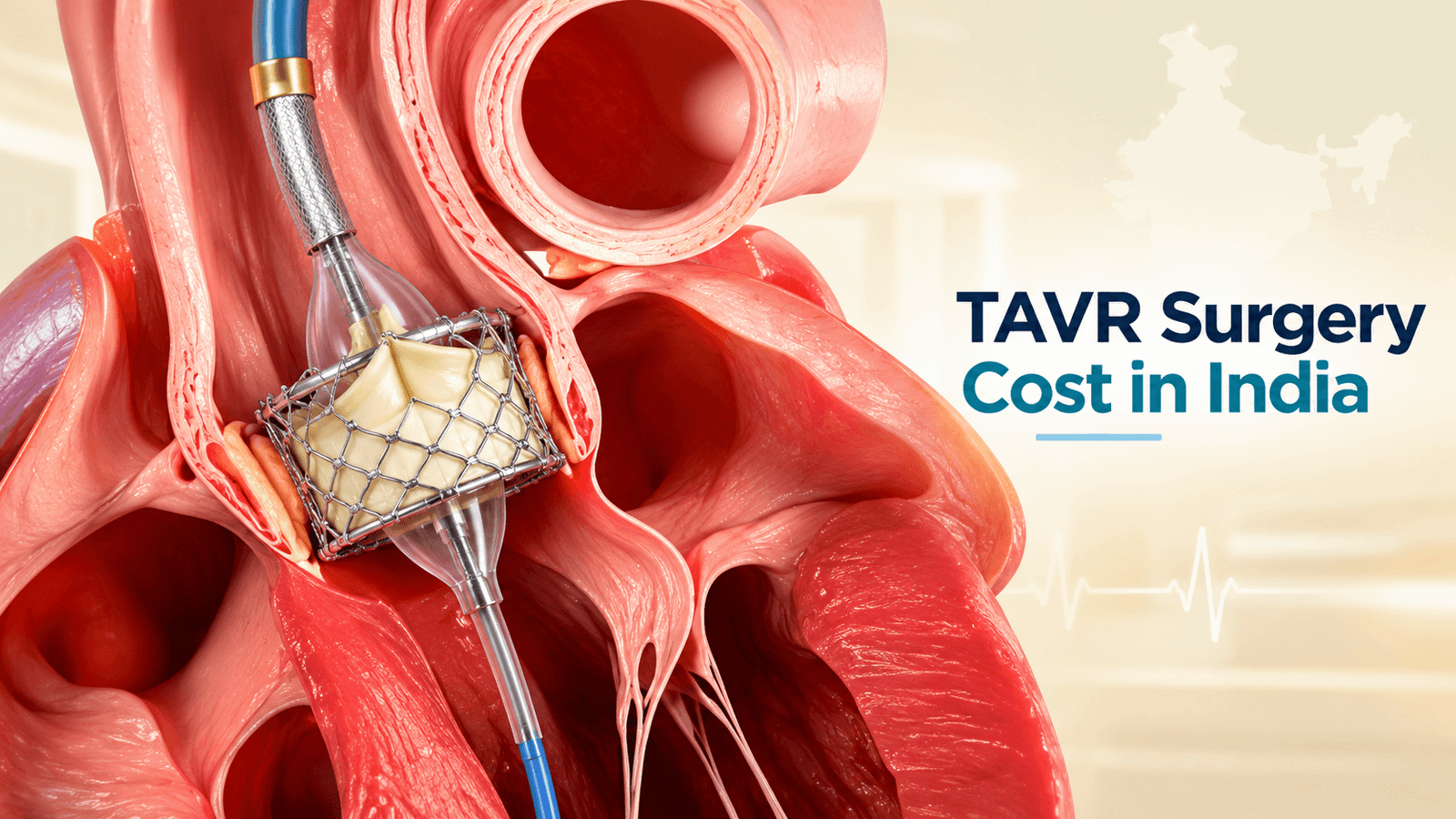
TAVR stands for transcatheter aortic valve replacement. TAVI, or transcatheter aortic valve implantation, is another name for the same general procedure.
The aortic valve controls blood flow from the left ventricle into the aorta, which carries blood to the body. When the valve becomes severely narrowed, the heart must work harder to pump blood through the smaller opening. This condition is known as aortic stenosis.
TAVR uses a catheter to deliver a collapsible artificial valve to the heart. The new valve is expanded inside the diseased valve to improve blood flow. The procedure is generally performed in a specialised catheterisation laboratory or hybrid operating room, with imaging guidance and a multidisciplinary cardiac team.
What makes TAVR different from open-heart surgery?
- It usually avoids a full chest incision.
- The valve is delivered using a catheter, often through an artery in the groin.
- It may allow a shorter hospital stay for suitable patients.
- It requires specialised imaging, equipment and a transcatheter valve.
- It is not suitable for every type of aortic valve disease.
Although TAVR is less invasive in terms of surgical access, it remains a major cardiac intervention with important risks and follow-up requirements.
Who May Need TAVR Treatment?
TAVR is mainly used for selected patients with severe aortic stenosis. A cardiologist and structural-heart team assess whether the procedure is appropriate. If you are unsure, you can request a second opinion.
Severe aortic stenosis
Aortic stenosis occurs when the aortic valve becomes narrowed, often because of age-related calcification or other valve abnormalities. Symptoms may include:
- Breathlessness during activity or at rest.
- Chest pain or pressure.
- Dizziness or fainting.
- Fatigue and reduced exercise tolerance.
- Reduced ability to perform everyday activities.
Not everyone with aortic stenosis needs immediate valve replacement. The decision depends on disease severity, symptoms, heart function and other clinical findings. For related symptom guides, read about the warning signs of cardiovascular disease and the signs and symptoms of congestive heart disease.
Patients who may be at increased risk from open surgery
Some patients may be considered for TAVR because conventional surgery presents substantial risks. However, the decision is not based on age or surgical risk alone. The team also evaluates valve anatomy, blood vessels, other medical conditions, life expectancy, likely benefit and the patient's preferences.
Patients with previous heart surgery
A person who has previously undergone cardiac surgery may sometimes be considered for a transcatheter valve procedure. Suitability depends on the existing valve, anatomy and individual clinical circumstances. TAVR is not automatically the preferred option for every patient who has had previous surgery.
TAVR Cost by Valve Type and Treatment Complexity
The artificial valve is one of the major cost components of TAVR. Transcatheter valves vary in design, delivery system, size and expansion mechanism. The appropriate device depends on the patient's anatomy and the clinical team's assessment.
| Treatment consideration | How it may affect cost |
|---|---|
| Transcatheter valve model | Different valve systems have different prices |
| Valve size and anatomy | May affect device selection and procedural planning |
| Femoral artery access | Often used when anatomy permits |
| Alternative access route | May require additional planning or specialised equipment |
| Complex calcification | Can increase procedural complexity |
| Additional coronary treatment | May add costs if another procedure is required (see angioplasty and stent costs) |
| Pacemaker implantation | May add expenses if a clinically significant rhythm problem develops |
| Extended ICU stay | Increases hospital charges |
A hospital should specify the planned valve system and whether the device is included in the quoted package.
Get Your Personalised TAVR Cost Estimate
Share your echocardiogram, CT scan, ECG or previous cardiac reports and details — our cardiac care team will respond on WhatsApp within 48 hours.
By submitting, you agree to be contacted by Azzocare's care team.
Request Sent!
Our team will WhatsApp you back shortly.
TAVR Surgery Cost in Major Indian Cities
TAVR is a specialised procedure and is not available at every hospital that performs conventional cardiac surgery. Costs vary by hospital, valve system, clinical complexity and package inclusions. The following are broad planning estimates for comparison, not verified tariffs for every hospital in each city.
| City | Approx. USD | Approximate TAVR planning range |
|---|---|---|
| TAVR surgery cost in Delhi NCR | $19,790–$39,585+ | ₹19–38 lakh or more |
| TAVR surgery cost in Mumbai | $20,835–$39,585+ | ₹20–38 lakh or more |
| TAVR surgery cost in Chennai | $18,750–$36,460+ | ₹18–35 lakh or more |
| TAVR surgery cost in Bengaluru | $19,790–$37,500+ | ₹19–36 lakh or more |
| TAVR surgery cost in Hyderabad | $18,750–$36,460+ | ₹18–35 lakh or more |
| TAVR surgery cost in Kolkata | $18,750–$35,420+ | ₹18–34 lakh or more |
| TAVR surgery cost in Ahmedabad | $18,750–$35,420+ | ₹18–34 lakh or more |
These figures are broad estimates assembled from published third-party planning information, not independently verified city-specific hospital prices. They should not be interpreted as a guarantee that every city has a hospital offering the same procedure or price.
Before choosing a city, confirm that the named hospital has an experienced structural-heart team, the appropriate valve device, advanced cardiac imaging, ICU support and cardiac surgical backup. You can browse our partner hospitals and share your reports for a personalised estimate.
TAVR Surgery Cost in India Compared With Other Countries
Patients sometimes compare India with other countries when considering treatment. However, advertised prices may cover different services, so the same procedure and package inclusions should be compared.
| Country | General Cost Context |
|---|---|
| India | Published hospital estimates commonly fall around ₹18–35 lakh ($18,750–$36,460), with higher costs possible |
| United States | Often considerably more expensive for self-pay patients; insurance and hospital charges affect the final bill |
| United Kingdom | NHS eligibility and private treatment prices are different cost categories |
| Thailand | Price depends on the hospital, valve system and treatment package |
| United Arab Emirates | Hospital, insurance and clinical requirements affect the estimate |
| Germany | Costs depend on insurance coverage, hospital and clinical complexity |
These are broad comparisons rather than verified national averages. A patient's actual costs depend on their diagnosis, treatment plan, hospital and coverage.
International patients should ask for a written quotation that includes the valve device, procedure, anaesthesia, ICU, room, investigations, medicines and follow-up. Travel, accommodation and additional days of recovery may be separate expenses. Our guides on medical tourism in India and the India medical visa can help you plan.
What Is Included in a TAVR Package?
A TAVR package can include several components, but hospitals differ in what they cover.
| Package component | What to confirm |
|---|---|
| Transcatheter valve | Exact device and whether it is included |
| Cardiologist and procedural team | Professional fees and specialist consultations |
| Catheter laboratory | Procedure and equipment charges |
| Anaesthesia | Whether anaesthesia support is included |
| CT and echocardiography | Whether all planning investigations are covered |
| ICU or monitored bed | Included days and additional-day rates |
| Hospital room | Room category and daily limit |
| Medicines and consumables | Included items and exclusions |
| Pacemaker or additional procedure | Whether additional treatment is billed separately |
| Follow-up | Post-procedure assessment and echocardiography |
Request an itemised estimate before admission. A package that excludes the valve device or includes only a limited hospital stay may not reflect the final amount payable.
How Is TAVR Performed?
The procedure is planned using cardiac imaging and an assessment of the patient's blood vessels and valve anatomy.
Step 1: Pre-procedure assessment
The team reviews the patient's medical history, echocardiography, CT imaging and other tests to determine whether TAVR is appropriate.
Step 2: Catheter access
The catheter is commonly inserted through an artery in the groin. An alternative access route may be considered if the usual route is unsuitable.
Step 3: Valve delivery
The replacement valve is guided to the heart using imaging. It is positioned within the diseased aortic valve and expanded according to the device's design.
Step 4: Valve function assessment
The team checks valve function, blood flow and possible complications. Heart rhythm, blood pressure and access-site bleeding are monitored.
Step 5: Post-procedure observation
The patient is monitored in a recovery area, cardiac ward or ICU as needed. The length of stay depends on recovery, the patient's medical condition and any complications.
Tests Required Before TAVR
The exact investigations depend on the patient and the hospital's protocol. For a general idea of test prices, see our guide to the cost of cardiac tests in Delhi.
- Echocardiography: Evaluates aortic stenosis severity, valve function and heart performance.
- CT scan: Helps assess valve anatomy, aortic dimensions and the blood vessels used to deliver the valve.
- ECG: Checks heart rhythm and electrical activity.
- Blood tests: Assess blood counts, kidney function and other factors relevant to the procedure.
- Coronary assessment: Coronary CT or angiography may be recommended to evaluate coronary artery disease. See our coronary angiography cost guide. If coronary disease is found, treatment options may include angioplasty or bypass surgery.
- Medical and anaesthesia review: The team reviews current medicines, allergies, previous procedures and other medical conditions.
Ask whether these investigations are included in the package or billed separately.
Recovery After TAVR
Many patients recover more quickly after TAVR than after conventional open-heart surgery, but recovery varies. The hospital team monitors heart rhythm, blood pressure, kidney function, valve performance and the catheter access site.
After discharge, the patient may need:
- Follow-up appointments and echocardiography.
- Prescribed medicines and medication review.
- Monitoring for rhythm problems or access-site complications.
- Gradual return to activity according to medical advice.
- Cardiac rehabilitation when recommended.
Some patients develop conduction problems or other complications that require additional treatment, including a pacemaker in selected cases. The treating team should explain activity restrictions, wound care and follow-up arrangements before discharge.
Seek urgent medical care for sudden severe breathlessness, chest pain, fainting, new weakness or other potentially serious symptoms.
Once your doctor clears you, heart-healthy habits support long-term cardiac health. See our guides on exercise for heart health at home and how to improve heart health naturally.
Is TAVR Covered by Health Insurance in India?
TAVR may be covered under some health insurance policies, subject to policy terms, exclusions, preauthorization and insurer approval. Before admission, confirm:
- Whether the hospital is in the insurer's network.
- Whether TAVR is covered under the policy.
- Whether the transcatheter valve device is included.
- Whether preauthorization is required.
- Whether room and ICU limits apply.
- Whether copayment or deductible applies.
- What documents are needed for reimbursement.
Government scheme reimbursement rates should not automatically be treated as the total private hospital cost. The official CGHS procedure rate and the implant reimbursement rate are separate entries, and eligibility and approvals may apply. Obtain written confirmation from the insurer or scheme administrator and the hospital billing department.
TAVR vs. Surgical Aortic Valve Replacement: Which Is More Suitable?
TAVR and surgical aortic valve replacement (SAVR) are different approaches to treating aortic valve disease. For surgical pricing, see our aortic valve replacement cost in India guide.
| Factor | TAVR/TAVI | Surgical AVR |
|---|---|---|
| Access | Catheter-based | Surgical access to the heart |
| Chest incision | Usually avoids a full chest incision | Commonly involves a chest incision |
| Valve | Transcatheter prosthetic valve | Surgical prosthetic valve |
| Recovery | May be shorter for suitable patients | Depends on surgery and patient condition |
| Cost | Often higher because of the specialised device | Often lower, but varies by hospital and complexity |
| Suitability | Depends on valve anatomy, disease and clinical factors | May be preferred for certain anatomical or combined surgical needs |
Neither option is universally best. A heart team should consider the patient's age, anatomy, other medical conditions, life expectancy, treatment goals and procedural risks before recommending a treatment.
How to Choose a Hospital for TAVR
Cost matters, but the treatment decision should also consider the experience and resources of the structural-heart team. Compare profiles on our best cardiology doctors in India page, and confirm that the hospital has a TAVR programme, advanced cardiac imaging, cardiac ICU and cardiac surgical backup.
Cardiac centres in our partner network include Fortis Escorts Heart Institute, Medanta – The Medicity, BLK-Max Super Speciality Hospital, Indraprastha Apollo Hospitals and Artemis Hospital, Gurugram. Treatment availability and pricing differ by hospital, so confirm TAVR services and request a written quotation from each.
Conclusion
The TAVR surgery cost in India generally ranges from ₹18 lakh to ₹35 lakh ($18,750–$36,460) in published estimates, with complex cases reaching ₹38 lakh or more. The valve device is a major part of the bill, and ICU stay, investigations and additional procedures such as a pacemaker can change the total.
Before booking, confirm the valve system, package inclusions, insurance coverage and any additional charges with the hospital. To see how this fits with other procedures, browse our treatment cost guides.
How Azzocare Helps International Patients
TAVR costs depend on the diagnosis, valve system, hospital and individual treatment requirements. A personalised estimate is more useful than relying on an online average. For an initial cost assessment, prepare:
- Latest echocardiography report
- CT scan or other cardiac imaging, if available
- ECG and relevant investigation reports
- Current medication list
- Previous cardiac surgery records
- Relevant medical history and recent test results
Share your reports and the recommended procedure so our team can help you understand the likely treatment pathway, hospital expenses and questions to ask before admission. International patients can also ask about medical visa assistance, accommodation, transport and follow-up arrangements. You can also book an appointment directly.
Frequently Asked Questions
How much does TAVR surgery cost in India?
Published hospital estimates range from approximately ₹18 lakh–₹35 lakh ($18,750–$36,460). Some complex cases may cost ₹38 lakh or more. The actual amount depends on the valve device, hospital, investigations, ICU stay and patient condition.
What is the cost of a TAVR valve in India?
The valve device alone may cost approximately ₹15 lakh–₹25 lakh ($15,625–$26,040), depending on the model and procurement arrangements. This is not the complete treatment price; procedure, hospital and other charges may be additional.
Is TAVR cheaper than open-heart surgery?
TAVR is often more expensive than conventional surgical aortic valve replacement because of the specialised transcatheter valve and equipment. The final difference depends on the hospital, treatment plan, hospital stay and any additional procedures.
Is TAVR suitable for every patient with aortic stenosis?
No. Suitability depends on disease severity, valve anatomy, blood vessel access, other medical conditions and the expected benefits and risks. A specialist heart team should assess the patient.
How long does a patient stay in hospital after TAVR?
The stay varies according to recovery, heart rhythm, other medical conditions and complications. Some patients leave within a few days, while others need longer monitoring. The treating hospital should provide an individual estimate.
Does TAVR require a pacemaker?
Not every patient needs a pacemaker. However, TAVR can affect the heart's electrical conduction system, and some patients require pacemaker implantation. This possibility should be discussed during the pre-procedure consultation.
Can international patients travel to India for TAVR?
International patients may seek an assessment in India, but they should send their reports for specialist review before arranging travel. Travel timing should account for investigations, treatment, recovery and follow-up. The treating team must confirm when travel is appropriate.
Is TAVR a permanent solution?
TAVR can provide substantial improvement for appropriately selected patients, but valve durability and future treatment needs vary. Regular follow-up and echocardiography help monitor the implanted valve.
Related Pages
Sources Checked
- Apollo Hospitals — Transcatheter Aortic Valve Replacement (TAVR) — published cost range of ₹21 lakh–₹35 lakh and cost factors.
- Medicover Hospitals — TAVR Surgery Cost — published estimate of ₹18 lakh–₹30 lakh and cost components.
- Yashoda Hospitals — TAVI Procedure Cost — valve and hospital cost components.
- Medanta — TAVR/TAVI Treatment — published starting-price context.
- CGHS — TAVR/TAVI Rate Listing — scheme procedure rate information; this should not be treated as a private hospital package quote.
Editorial note: City and component figures on this page are indicative planning estimates, not guaranteed prices. Before making a decision, obtain a current written quotation from the relevant hospital for your actual budget.
Medical Disclaimer
This article is for general information and financial planning only, with indicative cost estimates as of October 2026. It does not replace a cardiologist's assessment. Treatment eligibility, risks and final costs must be confirmed by the treating hospital, and a current written quotation should be obtained before proceeding.

Mohammad Nafis Khan is an SEO and digital marketing professional with over 5 years of experience creating search-optimized, patient-focused content for healthcare and medical websites. He follows E-E-A-T principles to make complex healthcare topics clear and accessible, structuring articles around what patients actually search for.
Read full bio
Dr. Md Ehsanullah is a physician with 4+ years of clinical experience in internal and general medicine. He completed his MBBS and MD from Asian Medical University, Kyrgyzstan, and currently practices at VMMC & Safdarjung Hospital, New Delhi. He reviews Azzocare's healthcare content for clinical accuracy, ensuring medical information aligns with current best practices and E-E-A-T principles.
Read full bio