
ICD Implantation Cost in India
Single-chamber, dual-chamber, S-ICD and CRT-D costs, procedure, recovery and risks — with a free personalised estimate within 48 hours.
Top Hospitals
for ICD Implantation
Find hospitals with electrophysiology laboratories, cardiac ICU, device follow-up clinics and itemised written estimates.
Explore Hospitals →Top Electrophysiologists
for Sudden Cardiac Arrest Risk
Connect with cardiologists experienced in ICD, S-ICD and CRT-D implantation and long-term device monitoring.
Find Specialists →Direct answer: ICD implantation cost in India generally ranges from US$3,200 to US$10,650 (approximately ₹3 lakh to ₹10 lakh), depending on the device type, hospital, cardiologist’s fees, procedure complexity and length of hospital stay. A subcutaneous ICD or CRT-D may cost more. The final estimate depends on the patient's heart condition and the device recommended by the electrophysiologist.
| Treatment Information | Details |
|---|---|
| Procedure | Implantable cardioverter defibrillator (ICD) implantation under the skin |
| Purpose | Detect and treat dangerous ventricular arrhythmias (VT and VF) |
| Device Types | Single-chamber, dual-chamber, subcutaneous (S-ICD), CRT-D |
| Pre-Procedure Tests | ECG, echocardiogram, Holter, blood tests, see cardiac test costs |
| Related Guide | Warning Signs of Cardiovascular Disease |
| Performed By | Cardiologist & Electrophysiologist |
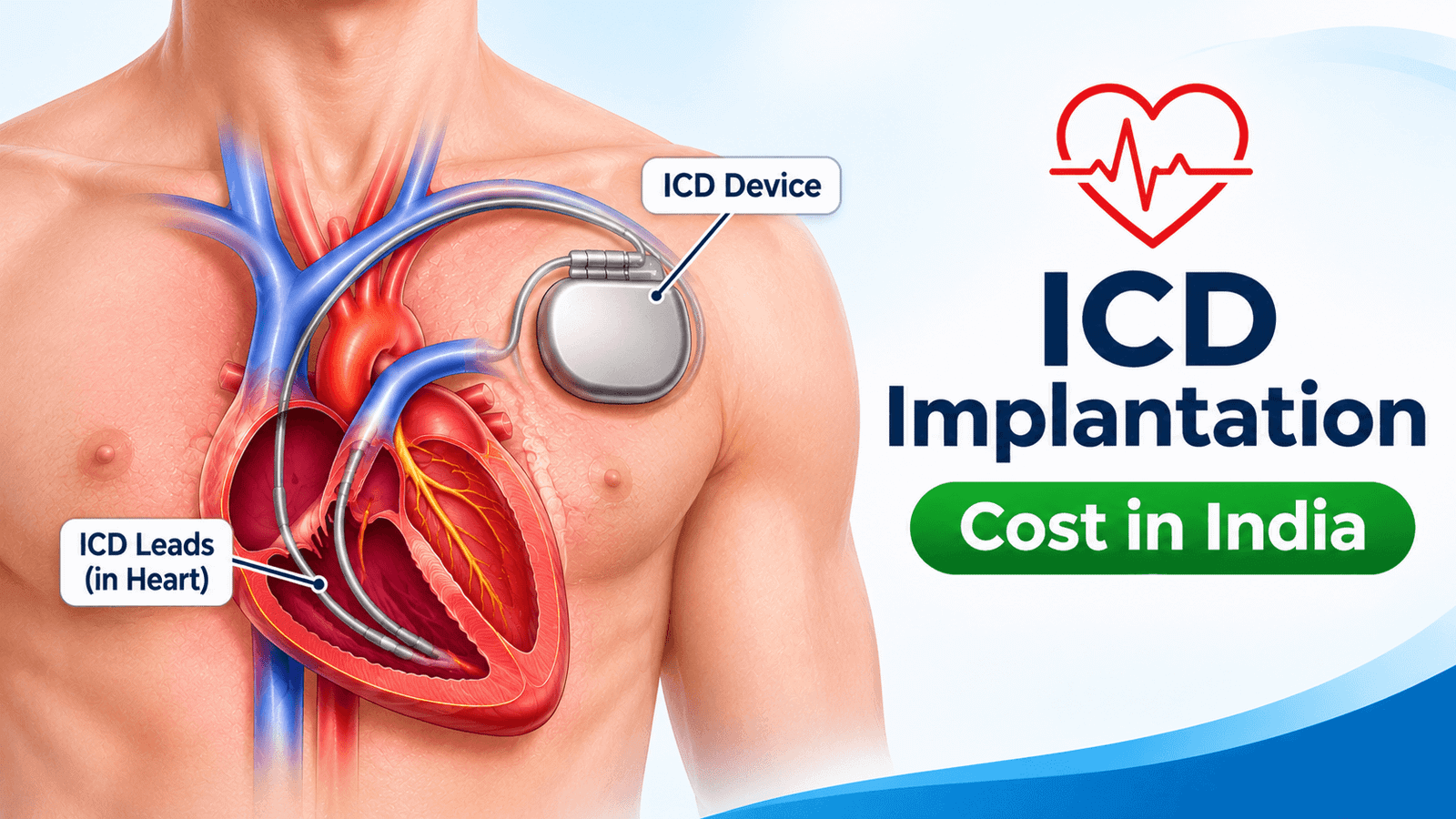
What Is an Implantable Cardioverter Defibrillator (ICD)?
An implantable cardioverter defibrillator (ICD) is a small electronic device placed under the skin to monitor the heart's rhythm and detect potentially life-threatening abnormal heartbeats.
When the device detects a dangerous rhythm, such as ventricular tachycardia (VT) or ventricular fibrillation (VF), it can deliver electrical therapy to restore a safer heart rhythm. Depending on its design, an ICD may also provide pacing support.
ICDs are commonly recommended for people who have survived sudden cardiac arrest or have a significant risk of developing dangerous ventricular arrhythmias.
Unlike a conventional pacemaker, which mainly treats abnormally slow heart rhythms, an ICD can deliver a high-energy shock to treat certain life-threatening fast rhythms.
ICD Implantation Cost in India: Price by Device Type
The cost of ICD implantation in India varies according to the device selected, its features and the hospital's pricing structure.
| ICD device type | Estimated cost (USD) | Estimated cost (INR) |
|---|---|---|
| Single-chamber ICD | US$3,200–US$6,400 | ₹3–6 lakh |
| Dual-chamber ICD | US$4,250–US$8,500 | ₹4–8 lakh |
| Subcutaneous ICD (S-ICD) | US$8,500–US$14,900 | ₹8–14 lakh |
| CRT-D implantation | US$8,500–US$15,950 | ₹8–15 lakh |
These are indicative planning estimates, not fixed hospital quotations. Device prices, procedure charges and package inclusions can vary. The USD conversions are approximate, using around ₹94 per US dollar.
Single-Chamber ICD Cost in India
A single-chamber ICD generally has one lead positioned in the heart, usually in the right ventricle. It monitors heart rhythm and delivers appropriate therapy when a dangerous ventricular arrhythmia is detected.
- Estimated cost: US$3,200–US$6,400
- Approximate INR cost: ₹3–6 lakh
The final price depends on the ICD model, lead system, device manufacturer and hospital package.
Dual-Chamber ICD Cost in India
A dual-chamber ICD generally uses two leads to monitor electrical activity in the right atrium and right ventricle. It may provide additional rhythm information and pacing functions for selected patients.
- Estimated cost: US$4,250–US$8,500
- Approximate INR cost: ₹4–8 lakh
Not every patient needs a dual-chamber device. The electrophysiologist selects the appropriate system according to the patient's rhythm condition and clinical requirements.
Subcutaneous ICD (S-ICD) Cost in India
A subcutaneous ICD is implanted beneath the skin, with its electrode positioned under the skin rather than inside the heart through a vein. It can be an option for selected patients who need protection from dangerous ventricular arrhythmias.
- Estimated cost: US$8,500–US$14,900
- Approximate INR cost: ₹8–14 lakh
An S-ICD does not provide the same conventional pacing capabilities as a transvenous ICD. Therefore, it is not suitable for every patient.
CRT-D Implantation Cost in India
Cardiac resynchronization therapy with a defibrillator (CRT-D) combines heart-failure resynchronization pacing with defibrillator protection.
It is used in selected patients with heart failure and electrical conduction abnormalities who also meet criteria for defibrillator therapy.
- Estimated cost: US$8,500–US$15,950
- Approximate INR cost: ₹8–15 lakh
CRT-D is a more complex device system than a standard ICD and generally requires an additional lead to coordinate the contraction of the heart's ventricles.
Published Reference Prices
The planning ranges above are informed by several published pricing references. Their scopes differ, so the figures should not be treated as directly interchangeable.
| Published source and item | Published figure |
|---|---|
| Star Health: overall ICD implantation | US$3,190–US$5,320 (₹3–₹5 lakh) |
| Star Health: ICD device only, city-wise | US$2,450–US$4,790 (₹2.3–₹4.5 lakh) |
| CureBridge: single-chamber ICD | US$5,320–US$8,510 (₹5–₹8 lakh) |
| CureBridge: dual-chamber ICD | US$6,385–US$10,640 (₹6–₹10 lakh) |
| CureBridge: subcutaneous ICD (S-ICD) | US$8,510–US$14,895 or more (₹8–₹14 lakh or more) |
| CureBridge: CRT-D | US$8,510–US$15,960 or more (₹8–₹15 lakh or more) |
| GAF Healthcare: international-patient planning range | US$8,000–US$18,000 |
Star Health reports device and procedure costs separately and lists a lower overall range, while CureBridge lists higher device-wise ranges. GAF Healthcare gives an international-patient planning range that is not a quotation and lists a typical hospital stay of 1–4 nights. Actual hospital quotations can fall outside the planning ranges shown in this guide.
Get Your Personalised TAVR Cost Estimate
Share your echocardiogram, CT scan, ECG or previous cardiac reports and details — our cardiac care team will respond on WhatsApp within 48 hours.
By submitting, you agree to be contacted by Azzocare's care team.
Request Sent!
Our team will WhatsApp you back shortly.
ICD Implantation Cost in Major Indian Cities
ICD implantation is available at specialised cardiac hospitals in several Indian cities. However, the actual price depends on the hospital, device model, specialist and treatment requirements.
| City | Cost information |
|---|---|
| Delhi NCR | Hospital-specific quotation required |
| Mumbai | Hospital-specific quotation required |
| Chennai | Hospital-specific quotation required |
| Bengaluru | Hospital-specific quotation required |
| Hyderabad | Hospital-specific quotation required |
| Kolkata | Hospital-specific quotation required |
| Ahmedabad | Hospital-specific quotation required |
The national estimates in this guide should not be interpreted as verified city-specific hospital tariffs. Patients should request an itemised quotation from their chosen hospital before making travel or treatment arrangements. You can browse our hospitals to compare cardiac centres.
What Factors Affect ICD Implantation Cost in India?
Several factors influence the overall cost of ICD implantation. Two patients undergoing the same general procedure may receive different estimates because their medical needs and selected devices are not necessarily the same.
1. Type of ICD Device
The device is one of the most important cost factors. Single-chamber, dual-chamber, subcutaneous ICD and CRT-D systems have different designs, features and lead requirements.
2. Device Manufacturer and Model
Different manufacturers offer ICD systems with varying features, battery specifications, monitoring capabilities and programming options. The selected model can significantly affect the device price.
3. Hospital and Specialist Fees
The cost may vary according to the hospital's infrastructure, cardiac electrophysiology facilities, specialist experience and room category.
4. Diagnostic Tests Before Implantation
Patients may need several investigations before the procedure, including:
- Electrocardiogram (ECG)
- Echocardiogram
- Holter monitoring
- Blood investigations
- Cardiac imaging, when indicated
- Electrophysiological evaluation, when required
The tests recommended depend on the patient's medical history and clinical condition. For indicative prices, see cardiac test costs in Delhi. A routine health checkup can also help track heart health.
5. Hospital Stay and Monitoring
Some patients can leave the hospital relatively quickly, while others require additional monitoring or intensive care. Longer hospitalisation can increase the overall bill.
6. Additional Medical Conditions
Patients with heart failure, coronary artery disease, kidney disease or other medical conditions may require additional investigations, medicines or treatment before and after ICD implantation.
What Is Included in an ICD Implantation Package?
The inclusions vary between hospitals. A package may cover some or all of the following:
- Cardiologist and electrophysiologist consultation
- ICD implantation procedure charges
- Device placement and lead insertion
- Operating or catheterisation laboratory charges
- Anaesthesia or sedation, where applicable
- Routine investigations
- Hospital room or cardiac care unit stay
- Routine medicines and consumables
- Initial device programming and monitoring
Important: The ICD device itself may be charged separately from the implantation procedure. Always confirm whether the quoted price includes the complete device, leads, taxes, medicines, investigations and hospital stay.
What Is the ICD Implantation Procedure?
ICD implantation is generally performed by a cardiac electrophysiologist or an appropriately trained cardiologist in a specialised cardiac procedure room.
Step 1: Pre-Procedure Evaluation
The medical team reviews the patient's heart condition, previous cardiac events, ECG, echocardiogram and other relevant investigations. The specialist confirms whether an ICD is appropriate and selects the device type.
Step 2: Anaesthesia or Sedation
Local anaesthesia with sedation is commonly used for conventional transvenous ICD implantation. The anaesthesia plan depends on the patient's condition and the selected procedure.
Step 3: Device Placement
For a conventional transvenous ICD, the doctor usually makes a small incision below the collarbone. One or more leads are guided through a vein into the appropriate heart chambers. The ICD generator is placed beneath the skin, usually near the upper chest.
For a subcutaneous ICD, the generator and electrode are positioned under the skin without placing a lead inside the heart through a vein.
Step 4: Device Testing and Programming
The medical team checks the device connections and programs its settings according to the patient's needs. Additional testing may be performed when clinically indicated.
Step 5: Recovery and Monitoring
After implantation, the patient is monitored for complications, wound healing and appropriate device function. The doctor provides instructions about arm movement, wound care, medicines and follow-up appointments.
Who May Need ICD Implantation?
An ICD may be recommended for people at increased risk of life-threatening ventricular arrhythmias. Some common clinical situations include:
- Survivors of sudden cardiac arrest caused by ventricular tachycardia or ventricular fibrillation
- Patients with documented sustained ventricular tachycardia
- Selected patients with a previous heart attack and significantly reduced heart function
- Certain patients with cardiomyopathy
- People with selected inherited heart rhythm conditions, such as long QT syndrome or Brugada syndrome
- Selected heart failure patients who meet clinical criteria for defibrillator therapy
Not everyone with heart disease needs an ICD. The decision depends on the underlying diagnosis, heart function, previous arrhythmias, expected benefit, other medical conditions and specialist assessment. Learn about the warning signs of cardiovascular disease.
ICD Implantation vs Pacemaker: What Is the Difference?
An ICD and a pacemaker are both implanted cardiac devices, but they serve different purposes.
| Feature | ICD | Pacemaker |
|---|---|---|
| Main purpose | Treats dangerous fast heart rhythms | Treats abnormally slow heart rhythms |
| Primary function | Detects and treats ventricular arrhythmias | Maintains an adequate heart rate |
| Electrical shock | Can deliver a therapeutic shock | Conventional pacemakers do not deliver defibrillation shocks |
| Common indication | Risk of sudden cardiac arrest | Bradycardia or heart block |
| Device type | Single-chamber, dual-chamber, S-ICD and CRT-D | Single-chamber, dual-chamber and CRT-P |
Some ICDs also provide pacing functions, but an ICD is not simply interchangeable with a conventional pacemaker. The correct device depends on the patient's diagnosis. For pacemaker pricing, see our guide to pacemaker implantation cost.
ICD vs CRT-D: Understanding the Difference
An ICD primarily detects and treats dangerous heart rhythms. A CRT-D combines this defibrillator function with cardiac resynchronization therapy.
CRT-D may be recommended for selected patients with heart failure and electrical conduction abnormalities who need both resynchronization and protection from life-threatening ventricular arrhythmias.
The two devices are not interchangeable. A specialist evaluates the patient's heart function, ECG findings and clinical history before recommending either system.
Recovery After ICD Implantation
Recovery depends on the patient's overall health, device type and whether the implantation was straightforward.
Many patients stay in the hospital for approximately one or two nights after an uncomplicated conventional ICD implantation, although the actual stay can be longer.
During recovery, patients may be advised to:
- Keep the incision clean and follow wound-care instructions.
- Avoid heavy lifting for the period recommended by the doctor.
- Limit excessive movement of the arm on the implant side initially.
- Attend scheduled device checks.
- Take prescribed medicines as directed.
- Carry their ICD identification card.
- Follow the doctor's instructions about driving and returning to normal activities.
Patients should seek medical attention if they experience fever, increasing redness, swelling, wound discharge, severe pain, fainting or repeated ICD shocks. Once your doctor clears you, you can read about exercise for heart health at home and how to improve heart health naturally.
Risks and Possible Complications of ICD Implantation
ICD implantation is a commonly performed cardiac procedure, but it carries potential risks.
Possible complications include:
- Bleeding or bruising near the implant site
- Infection
- Blood vessel or heart injury
- Pneumothorax (air around the lung)
- Lead displacement or malfunction
- Blood clots
- Inappropriate ICD shocks
- Device-related complications requiring revision
The likelihood of complications depends on the patient's health, procedure complexity and other clinical factors. The treating specialist should explain the individual risks before implantation.
Seek urgent medical attention for fainting, repeated ICD shocks, chest pain, severe breathlessness, fever or increasing redness, swelling or discharge at the implant site.
How Long Does an ICD Last?
An ICD's battery life depends on the device model, frequency of pacing, number of delivered therapies and other factors.
Many ICD batteries last several years, but there is no fixed lifespan for every patient. Regular device checks help monitor battery status and identify when generator replacement may be needed.
When the battery approaches depletion, the generator is generally replaced through another procedure. Whether existing leads can be retained depends on their condition and the patient's clinical situation.
ICD Implantation Cost in India vs Other Countries
India is considered by some international patients for cardiac treatment because it offers specialised hospitals and a range of device options. However, treatment costs cannot be compared accurately without checking what each quotation includes.
| Country | Cost comparison |
|---|---|
| India | Indicative estimates in this guide: US$3,200–US$10,650 |
| United States | Generally higher; obtain a hospital-specific estimate |
| United Kingdom | Depends on eligibility, healthcare pathway and private treatment arrangements |
| UAE | Depends on hospital, device and insurance coverage |
| Singapore | Requires a hospital-specific quotation |
| Thailand | Requires a hospital-specific quotation |
The figures for India are planning estimates, not guaranteed package prices. A reliable international comparison should account for the device, implantation, hospital stay, follow-up, medicines and any additional treatment. To plan your trip, read about medical tourism in India and the India medical visa.
Why Do International Patients Consider India for ICD Implantation?
International patients may consider India for ICD implantation for several reasons:
- Access to specialised cardiology and electrophysiology services
- Hospitals offering different ICD device options
- Availability of cardiac diagnostic facilities
- Treatment estimates across different hospital categories
- Assistance with medical appointments and treatment coordination
- Access to post-procedure follow-up and device monitoring arrangements
The most appropriate hospital should be selected according to the patient's medical requirements, the electrophysiologist's assessment and the quality of the proposed treatment plan. You can request a second opinion before deciding.
What Medical Reports Are Required Before ICD Implantation?
International patients should share their medical records with the treating cardiology team before travelling. Commonly requested documents include:
- Recent ECG reports
- Echocardiogram report showing left ventricular ejection fraction (LVEF)
- Holter monitoring or rhythm recordings, if available
- Previous angiography or cardiac imaging reports
- Discharge summaries from earlier hospital admissions
- Records of previous cardiac arrest or ventricular arrhythmia
- Current medication list
- Blood investigation reports
- Previous pacemaker or ICD details, if applicable
The hospital may request additional tests after reviewing the records. A doctor must confirm whether the patient is fit to travel and undergo the procedure.
Get an ICD Implantation Cost Estimate in India with Azzocare
If you or a family member has been advised to undergo ICD implantation, understanding the device options, hospital charges and expected treatment expenses can help with planning.
Azzocare assists international patients in exploring cardiac treatment options in India, coordinating medical consultations and requesting hospital cost estimates based on their medical records.
Share your recent ECG, echocardiogram, cardiac history and doctor's recommendation to begin the evaluation process.
Contact Azzocare to request an ICD implantation cost estimate in India and receive guidance on the next steps. You can also book an appointment, ask about visa assistance or see our treatment costs guides.
Frequently Asked Questions
What is the minimum ICD implantation cost in India?
The indicative starting estimate for ICD implantation is around US$3,200 (₹3 lakh). The final cost depends on the device type, hospital, specialist fees and package inclusions.
What is the cost of a dual-chamber ICD in India?
A dual-chamber ICD may cost approximately US$4,250–US$8,500 (₹4–8 lakh). The price varies according to the device model, hospital and clinical requirements.
Is CRT-D more expensive than a normal ICD?
Generally, yes. CRT-D combines cardiac resynchronization therapy with defibrillator protection and requires a more complex device system. Its estimated cost may range from US$8,500–US$15,950 (₹8–15 lakh).
Is ICD implantation an open-heart surgery?
No. Conventional transvenous ICD implantation is generally performed through a small incision, with leads guided through blood vessels into the heart. It does not usually require opening the chest.
How many days does a patient need to stay in the hospital?
Many patients stay approximately one or two nights after uncomplicated conventional ICD implantation. The duration depends on the patient's health, procedure and recovery.
Can an ICD prevent sudden cardiac death?
An ICD can detect and treat certain dangerous ventricular arrhythmias and reduce the risk of sudden cardiac death in appropriately selected patients. It does not prevent every cause of cardiac arrest or guarantee survival.
Does ICD implantation require lifelong follow-up?
Yes. Patients need regular device checks to monitor battery status, leads, programmed settings and any recorded abnormal heart rhythms. Remote monitoring may also be available with compatible devices.
Is ICD implantation covered by health insurance in India?
Coverage depends on the insurance policy, medical indication, hospital network, waiting periods and device-related terms. Patients should confirm coverage for both the ICD device and implantation procedure before admission.
What is the difference between an ICD and an AICD?
AICD stands for automatic implantable cardioverter defibrillator. It is another commonly used term for an implantable cardioverter defibrillator (ICD).
Can international patients travel to India for ICD implantation?
International patients may travel to India after their medical records have been reviewed and the treating cardiologist confirms that travel and treatment are appropriate. Patients should also arrange a follow-up and device-monitoring plan before returning home.
Related Pages
Research Sources
The estimates above are planning ranges informed by published pricing references. These sources have different pricing scopes, so their figures should not be treated as directly interchangeable.
- Government of India / institutional device schedule: lists reference prices for single-chamber ICD, dual-chamber ICD and CRT-D devices. View revised institutional schedule.
- Star Health: publishes an India ICD operation estimate and city-wise device price references. View ICD operation cost guide.
- CureBridge: publishes indicative estimates for single-chamber, dual-chamber, S-ICD and CRT-D implantation. View ICD implantation cost in India.
- GAF Healthcare: publishes an international-patient planning range of US$8,000–US$18,000. View ICD cost and treatment guide.
- American Heart Association: explains ICD function, indications and implantation. Read the ICD patient guide.
Medical Disclaimer
This article provides general information about ICD implantation and indicative treatment costs. It is not a substitute for medical advice, diagnosis or treatment. Device selection and implantation decisions must be made by a qualified cardiologist or cardiac electrophysiologist after reviewing the patient's individual condition.

Mohammad Nafis Khan is an SEO and digital marketing professional with over 5 years of experience creating search-optimized, patient-focused content for healthcare and medical websites. He follows E-E-A-T principles to make complex healthcare topics clear and accessible, structuring articles around what patients actually search for.
Read full bio
Dr. Md Ehsanullah is a physician with 4+ years of clinical experience in internal and general medicine. He completed his MBBS and MD from Asian Medical University, Kyrgyzstan, and currently practices at VMMC & Safdarjung Hospital, New Delhi. He reviews Azzocare's healthcare content for clinical accuracy, ensuring medical information aligns with current best practices and E-E-A-T principles.
Read full bio