
ICD Surgery Cost in India
Single-chamber, dual-chamber, S-ICD and CRT-D surgery costs, bill inclusions, recovery and risks — with a free personalised estimate within 48 hours.
Top Hospitals
for ICD Surgery
Find hospitals with electrophysiology laboratories, cardiac ICU, device follow-up clinics and itemised written estimates.
Explore Hospitals →Top Electrophysiologists
for Sudden Cardiac Arrest Risk
Connect with cardiologists experienced in ICD, S-ICD and CRT-D implantation and long-term device monitoring.
Find Specialists →Direct answer: The estimated ICD surgery cost in India ranges from US$3,200 to US$10,650 (approximately ₹3 lakh to ₹10 lakh) for many conventional ICD procedures. The price can be higher for a subcutaneous ICD or CRT-D system. The total bill depends on the device, implantation charges, hospital facilities, investigations and the patient's recovery requirements.
| Treatment Information | Details |
|---|---|
| Procedure | Implantation of an implantable cardioverter defibrillator (ICD) |
| Purpose | Detect and treat dangerous ventricular arrhythmias (VT and VF) |
| Device Types | Single-chamber, dual-chamber, subcutaneous (S-ICD), CRT-D |
| Pre-Surgery Tests | ECG, echocardiogram, Holter, blood tests, see cardiac test costs |
| Related Guide | Warning Signs of Cardiovascular Disease |
| Performed By | Cardiologist & Electrophysiologist |
ICD Surgery Cost in India by Device Type
The type of implantable cardioverter defibrillator (ICD) is a major factor in determining the total surgery cost. Different devices have different lead configurations and treatment capabilities.
| ICD surgery type | Estimated cost (USD) | Estimated cost (INR) |
|---|---|---|
| Single-chamber ICD | US$3,200–US$6,400 | ₹3–6 lakh |
| Dual-chamber ICD | US$4,250–US$8,500 | ₹4–8 lakh |
| Subcutaneous ICD (S-ICD) | US$8,500–US$14,900 | ₹8–14 lakh |
| CRT-D implantation | US$8,500–US$15,950 | ₹8–15 lakh |
Single-Chamber ICD Surgery
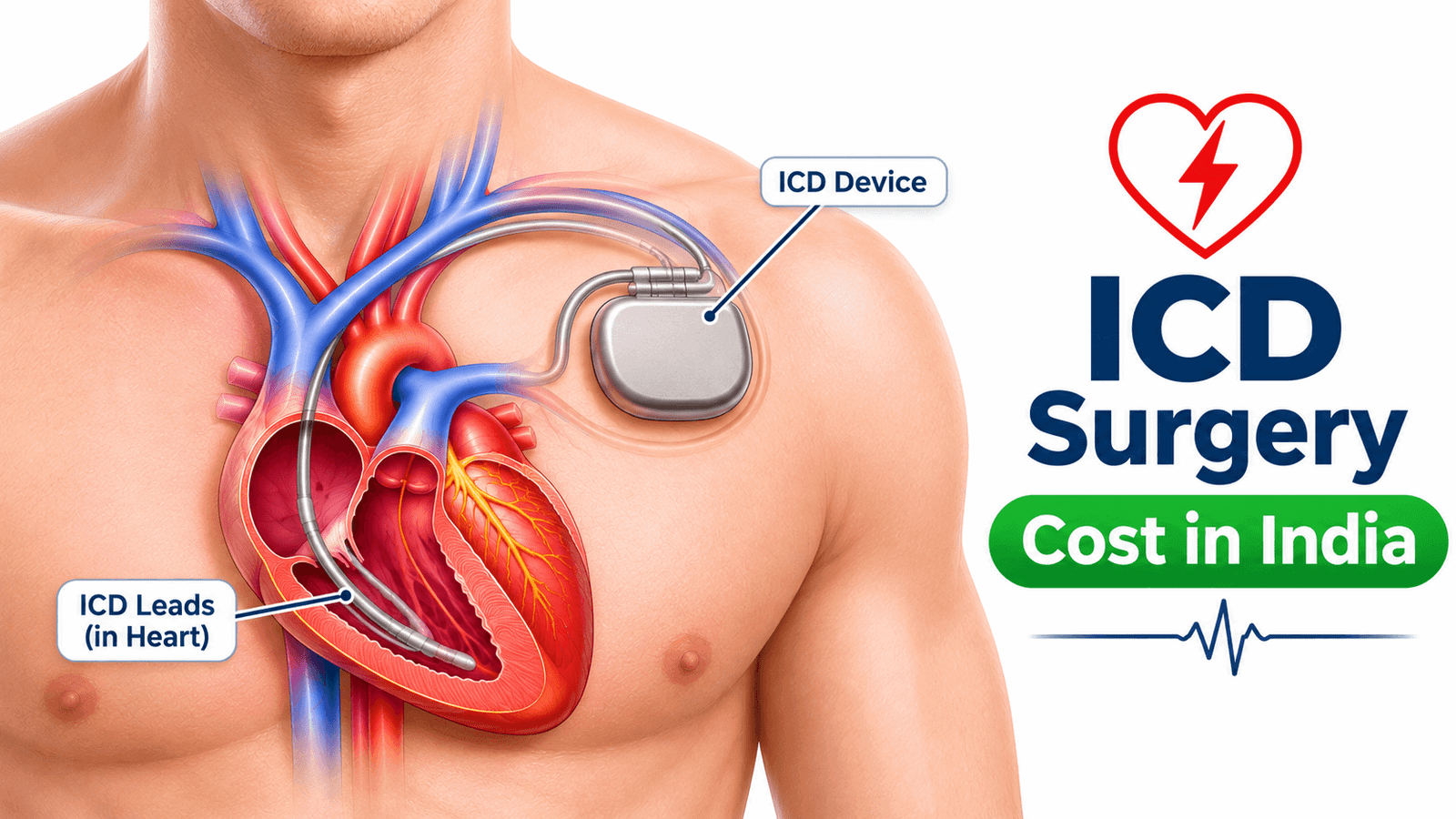
A single-chamber ICD generally uses one lead positioned in the right ventricle. It continuously monitors the heart's electrical rhythm and can deliver treatment when it detects certain dangerous ventricular arrhythmias.
Estimated cost: US$3,200–US$6,400 (₹3–6 lakh).
The final amount depends on the device model, lead, implantation package and hospital stay.
Dual-Chamber ICD Surgery
A dual-chamber ICD generally uses leads in the right atrium and right ventricle. It can provide additional rhythm information and pacing support for selected patients.
Estimated cost: US$4,250–US$8,500 (₹4–8 lakh).
A dual-chamber device is not automatically better for every patient. The electrophysiologist recommends the appropriate system after evaluating the patient's rhythm condition.
Subcutaneous ICD Surgery
A subcutaneous ICD (S-ICD) is placed beneath the skin. Its electrode is positioned under the skin rather than inside the heart through a vein.
Estimated cost: US$8,500–US$14,900 (₹8–14 lakh).
An S-ICD may be suitable for selected patients who need protection from dangerous ventricular arrhythmias but do not require conventional pacing. It cannot provide all the pacing functions available with a transvenous ICD.
CRT-D Implantation Surgery
CRT-D combines cardiac resynchronization therapy with an implantable defibrillator. It is used in selected patients with heart failure and electrical conduction abnormalities who also meet criteria for defibrillator treatment.
Estimated cost: US$8,500–US$15,950 (₹8–15 lakh).
CRT-D is more complex than a standard ICD system and generally involves additional lead placement.
Get Your Personalised TAVR Cost Estimate
Share your echocardiogram, CT scan, ECG or previous cardiac reports and details — our cardiac care team will respond on WhatsApp within 48 hours.
By submitting, you agree to be contacted by Azzocare's care team.
Request Sent!
Our team will WhatsApp you back shortly.
What Does the Total ICD Surgery Bill Include?
The total ICD surgery bill may contain several separate charges. Some hospitals offer a combined package, while others bill the device, procedure and hospital services individually.
| Cost component | What it covers |
|---|---|
| ICD device | Defibrillator generator and selected device model |
| Leads and accessories | Leads, electrodes and other required components |
| Cardiologist's fees | Specialist consultation and procedure-related professional charges |
| Implantation procedure | Procedure room, equipment and implantation charges |
| Anaesthesia or sedation | Anaesthesia services, when required |
| Diagnostic tests | ECG, echocardiogram, blood tests and other investigations |
| Hospital stay | Room, nursing and cardiac monitoring |
| Medicines and consumables | Medicines, dressings and procedure-related supplies |
| Device programming | Initial programming and checks after implantation |
Check the device cost separately. Published government and institutional schedules may list the ICD device and implantation procedure as separate items. For example, the 2025 CGHS schedule lists AICD implantation procedure charges excluding the device cost. A package quotation should therefore state clearly whether the generator and leads are included.
Why Does ICD Surgery Cost Differ Between Hospitals?
Two hospitals may quote different prices for the same broad procedure. The difference can come from the device selected, the patient's health and the services included in the package.
Device Brand and Technology
ICD systems are available in different models and configurations. Features such as MRI-conditional labelling, remote monitoring compatibility and advanced rhythm-detection algorithms may influence the device price.
Number and Type of Leads
A single-chamber ICD generally requires a different lead configuration from a dual-chamber ICD or CRT-D. The number and type of leads can affect both hardware and procedure costs.
Hospital Facilities
Hospitals with specialised electrophysiology laboratories, cardiac intensive care facilities and advanced monitoring services may have different charges from smaller facilities. Browse our hospitals to compare cardiac centres.
Patient's Medical Condition
A patient with heart failure, kidney disease, diabetes or another significant medical condition may need additional tests, medicines or monitoring. These requirements can increase the total bill. A routine health checkup can help track heart health.
Length of Hospital Stay
A straightforward procedure may involve a short admission. Complications or additional treatment may require a longer stay and increase the cost.
ICD Surgery Cost: Device Charges vs Implantation Charges
One reason patients receive different cost estimates is that the device price and the surgery price are not always quoted together.
For example, the 2025 CGHS rate schedule lists procedure charges for AICD implantation, excluding the device. The metro-city reference rates are shown below. These are scheme reference rates, not standard private-hospital package prices.
| CGHS procedure (excluding device) | Rate (USD) | Rate (INR) |
|---|---|---|
| Single-chamber AICD implantation | US$585 | ₹55,000 |
| Dual-chamber AICD implantation | US$613 | ₹57,585 |
| Combo-device implantation | US$690 | ₹64,900 |
A separate institutional schedule of rates, published by the Institute for Plasma Research, lists reference prices for ICD devices, plus applicable GST.
| Institutional schedule: device only | Reference price (USD) | Reference price (INR) |
|---|---|---|
| Single-chamber ICD | US$1,870 | ₹1,75,786 + GST |
| Dual-chamber ICD | US$3,990 | ₹3,75,000 + GST |
| CRT-D (combo device) | US$5,210 | ₹4,90,000 + GST |
These schedules illustrate why patients should ask for an itemised estimate. They are not a guarantee that a private hospital will offer treatment at the same rates. Star Health's general estimate of ₹3–5 lakh and Apollo Hospitals Lucknow's list of cost factors point the same way: the final price depends on the device and the hospital's estimate.
ICD Surgery Cost in Different Indian Cities
ICD implantation is available in major Indian healthcare centres. However, prices are not uniform across cities, and a hospital's device selection and package inclusions can make a significant difference.
| City | Pricing guidance |
|---|---|
| Delhi NCR | Request a hospital-specific estimate |
| Mumbai | Request a hospital-specific estimate |
| Chennai | Request a hospital-specific estimate |
| Bengaluru | Request a hospital-specific estimate |
| Hyderabad | Request a hospital-specific estimate |
| Kolkata | Request a hospital-specific estimate |
| Lucknow | Request a hospital-specific estimate |
| Ahmedabad | Request a hospital-specific estimate |
A published estimate for one city should not be treated as the confirmed price at every hospital in that location. Ask for a written quotation based on the recommended ICD model and your medical records.
Who Needs ICD Implantation Surgery?
An ICD may be recommended for patients who have experienced or are at significant risk of certain dangerous heart rhythm problems.
Common situations include:
- Previous cardiac arrest: People who have survived cardiac arrest caused by ventricular tachycardia or ventricular fibrillation may be assessed for an ICD.
- Sustained ventricular tachycardia: Selected patients with documented sustained VT may benefit from defibrillator protection.
- Reduced heart function: Some patients with significantly reduced left ventricular ejection fraction may meet criteria for an ICD.
- Cardiomyopathy: Certain forms of heart muscle disease can increase the risk of dangerous ventricular arrhythmias.
- Inherited rhythm conditions: Selected patients with conditions such as Brugada syndrome or long QT syndrome may require an ICD after specialist risk assessment.
- Heart failure: Some patients with heart failure may qualify for CRT-D when they meet the relevant clinical criteria.
An ICD is not necessary for every person with heart disease or an irregular heartbeat. The decision depends on the diagnosis, previous cardiac events, heart function, expected benefit and overall health. Learn about the warning signs of cardiovascular disease.
Tests Required Before ICD Surgery
Before recommending ICD implantation, the cardiologist or electrophysiologist reviews the patient's medical history and performs appropriate investigations.
Tests may include:
- Electrocardiogram (ECG)
- Echocardiogram to assess heart structure and pumping function
- Holter monitoring or other ambulatory rhythm monitoring
- Blood tests
- Cardiac MRI or other imaging when indicated
- Review of previous cardiac arrest or arrhythmia records
- Assessment of existing cardiac devices, if applicable
Not every patient needs every test. The medical team selects investigations according to the patient's condition. For indicative prices, see cardiac test costs in Delhi.
How Is ICD Implantation Surgery Performed?
Conventional ICD implantation is generally performed by a cardiac electrophysiologist in a specialised cardiac procedure room.
1. Preparation and Anaesthesia
The medical team reviews the patient's reports, confirms the device type and prepares the implantation site. Local anaesthesia with sedation is commonly used for conventional transvenous implantation, although the plan may vary.
2. Making the Incision
The doctor usually makes a small incision below the collarbone to create a pocket for the ICD generator.
3. Inserting the Leads
For a conventional transvenous ICD, the leads are guided through a vein into the appropriate heart chamber or chambers. Their position and electrical performance are checked.
For an S-ICD, the electrode is placed beneath the skin rather than inside the heart through a vein.
4. Connecting the Device
The leads are connected to the ICD generator, which is placed beneath the skin. The incision is then closed.
5. Programming and Monitoring
The device is programmed according to the patient's condition. The medical team checks its function and monitors the patient after the procedure.
Recovery After ICD Surgery
Recovery varies according to the patient's health, the type of ICD and whether any complications occur. Many patients remain in hospital for a short period after an uncomplicated implantation, but the treating team determines the appropriate discharge time.
After surgery, patients may be advised to:
- Keep the wound clean and follow the hospital's dressing instructions.
- Avoid heavy lifting for the period recommended by the doctor.
- Limit strenuous movement of the arm on the implant side initially.
- Take prescribed medicines as directed.
- Attend scheduled ICD checks.
- Carry their device identification card.
- Follow medical advice about driving, exercise and returning to work.
Contact the treating team if the wound becomes increasingly red, swollen, painful or starts discharging fluid. Fever, fainting or repeated ICD shocks require prompt medical assessment. If a shock is accompanied by chest pain, severe breathlessness or loss of consciousness, seek emergency medical care. Once your doctor clears you, you can read about exercise for heart health at home and how to improve heart health naturally.
Possible Risks of ICD Implantation Surgery
ICD implantation is an established cardiac procedure, but complications can occur.
Possible risks include:
- Bleeding or bruising around the device pocket
- Infection
- Lead displacement or malfunction
- Injury to a blood vessel or the heart
- Pneumothorax, or air around the lung
- Blood clots
- Inappropriate shocks
- Need for device or lead revision
The specialist should explain the potential benefits and risks based on the patient's individual condition.
Seek urgent medical attention for fainting, repeated ICD shocks, chest pain, severe breathlessness, fever or increasing redness, swelling or discharge at the implant site.
How Long Does an ICD Battery Last?
An ICD battery commonly lasts several years, but its lifespan depends on the model, pacing requirements and how often the device delivers therapy.
Regular device checks help the medical team monitor battery status and detect potential lead or programming issues. When the battery approaches depletion, the generator may need to be replaced. Whether the existing leads can be retained depends on their condition and the patient's needs.
ICD Surgery vs Pacemaker Surgery: Which Is Different?
ICD surgery and pacemaker surgery involve implanting cardiac devices, but the devices treat different rhythm problems.
| Comparison | ICD surgery | Pacemaker surgery |
|---|---|---|
| Main purpose | Treats certain dangerous fast heart rhythms | Treats slow heart rhythms |
| Common indication | Risk of ventricular tachycardia or ventricular fibrillation | Bradycardia or heart block |
| Electrical shock | Can deliver a defibrillation shock | Conventional pacemakers do not deliver defibrillation shocks |
| Pacing function | Available in many ICD systems | Main function of a pacemaker |
| Device selection | ICD, S-ICD or CRT-D, depending on indication | Single-chamber, dual-chamber or CRT-P |
An ICD may also provide pacing support, but it is not interchangeable with a conventional pacemaker. The treating specialist determines which device is appropriate. For pacemaker pricing, see our guide to pacemaker implantation cost.
Is ICD Surgery Covered by Health Insurance?
ICD implantation may be covered under health insurance when it is medically indicated and the policy includes the relevant treatment.
Coverage depends on:
- The policy's hospitalisation and procedure benefits
- Waiting periods and exclusions
- Whether the hospital is part of the insurer's network
- Device and implant coverage terms
- Room-rent limits and co-payment clauses
- Pre-authorisation requirements
Before admission, request confirmation of coverage for the ICD generator, leads, procedure, hospital stay and related investigations. Government scheme rates and private insurance reimbursement rules may differ.
Why Do International Patients Consider India for ICD Surgery?
India is one option for international patients seeking specialised cardiac treatment. Patients may consider Indian hospitals for access to electrophysiology services, different device options and treatment estimates. Read more about medical tourism in India and the India medical visa.
Before travelling, international patients should:
- Share recent ECG and echocardiogram reports.
- Provide records of previous cardiac events and hospital admissions.
- Send the current medication list.
- Obtain a specialist's opinion on the proposed device.
- Request a written estimate with device and procedure charges separated.
- Confirm whether the patient is fit to travel.
- Arrange follow-up and device monitoring after returning home.
A decision about travel and treatment should be made with the treating medical team, especially for patients with recent cardiac events or unstable symptoms. You can request a second opinion before deciding.
Get an ICD Surgery Cost Estimate in India with Azzocare
If a cardiologist has recommended ICD surgery, understanding the device options and complete hospital charges can help you plan treatment.
Azzocare helps international patients explore cardiac treatment options in India, coordinate medical consultations and request hospital estimates based on their medical records.
Share your ECG, echocardiogram, cardiac history and doctor's recommendation to begin the evaluation process.
Contact Azzocare to request an ICD surgery cost estimate in India and get guidance on the next steps. You can also book an appointment, ask about visa assistance or see our treatment costs guides.
Frequently Asked Questions
How much does ICD surgery cost in India?
The indicative cost is approximately US$3,200–US$10,650 (₹3–10 lakh) for many conventional ICD procedures. Subcutaneous ICD and CRT-D systems may cost more.
What is the cost of single-chamber ICD surgery?
A single-chamber ICD procedure may cost approximately US$3,200–US$6,400 (₹3–6 lakh), depending on the device, hospital and package inclusions.
Is dual-chamber ICD surgery more expensive?
It can be. A dual-chamber ICD uses a different lead configuration and may cost approximately US$4,250–US$8,500 (₹4–8 lakh).
Is the ICD device included in the surgery package?
Not always. Some hospitals quote the device separately from the implantation procedure. Ask for an itemised quotation that clearly identifies the generator, leads, procedure charges and hospital services.
How long does ICD surgery take?
The procedure duration varies with the device type, patient's anatomy and clinical complexity. The hospital can provide a more accurate estimate after reviewing the planned procedure.
How many days does a patient stay in hospital?
Many patients have a short hospital stay after uncomplicated conventional ICD implantation. The exact duration depends on recovery and the need for additional monitoring.
Is ICD surgery a major operation?
Conventional ICD implantation is usually performed through a small incision and does not normally require open-heart surgery. However, it is an important cardiac procedure that requires specialist assessment and monitoring.
Can a patient live normally with an ICD?
Many people return to daily activities after recovery, with some precautions and regular device checks. Exercise, driving and work recommendations depend on the patient's condition and local medical guidance.
Does an ICD cure heart disease?
No. An ICD treats certain dangerous heart rhythm disturbances. It does not cure the underlying heart condition, so patients may still need medicines, lifestyle management and other cardiac treatment.
Can international patients undergo ICD surgery in India?
Yes, international patients can seek an evaluation in India. They should share their medical records in advance and obtain confirmation from the treating specialist about travel fitness, treatment suitability and follow-up arrangements.
Related Pages
Sources Used for Cost and Medical Information
The estimates above are planning ranges informed by published pricing references. These sources have different pricing scopes, so their figures should not be treated as directly interchangeable.
- Star Health – ICD Operation Cost in India: publishes a general estimate of ₹3–5 lakh and indicative device prices. View ICD operation cost guide.
- CGHS Revised Rates, 2025: lists AICD implantation procedure charges separately from device costs. View CGHS revised rates.
- Institutional Schedule of Rates: provides reference prices for single-chamber ICD, dual-chamber ICD and CRT-D devices. View schedule of rates.
- Apollo Hospitals Lucknow – ICD Surgery: explains factors that influence the final hospital estimate. View ICD surgery page.
- CureBridge – ICD Implantation in India: publishes indicative costs for different ICD systems. View ICD implantation in India.
Medical Disclaimer
This article is for general educational purposes and provides indicative cost information. It does not replace professional medical advice, diagnosis or treatment. ICD selection and implantation decisions must be made by a qualified cardiologist or cardiac electrophysiologist.

Mohammad Nafis Khan is an SEO and digital marketing professional with over 5 years of experience creating search-optimized, patient-focused content for healthcare and medical websites. He follows E-E-A-T principles to make complex healthcare topics clear and accessible, structuring articles around what patients actually search for.
Read full bio
Dr. Md Ehsanullah is a physician with 4+ years of clinical experience in internal and general medicine. He completed his MBBS and MD from Asian Medical University, Kyrgyzstan, and currently practices at VMMC & Safdarjung Hospital, New Delhi. He reviews Azzocare's healthcare content for clinical accuracy, ensuring medical information aligns with current best practices and E-E-A-T principles.
Read full bio