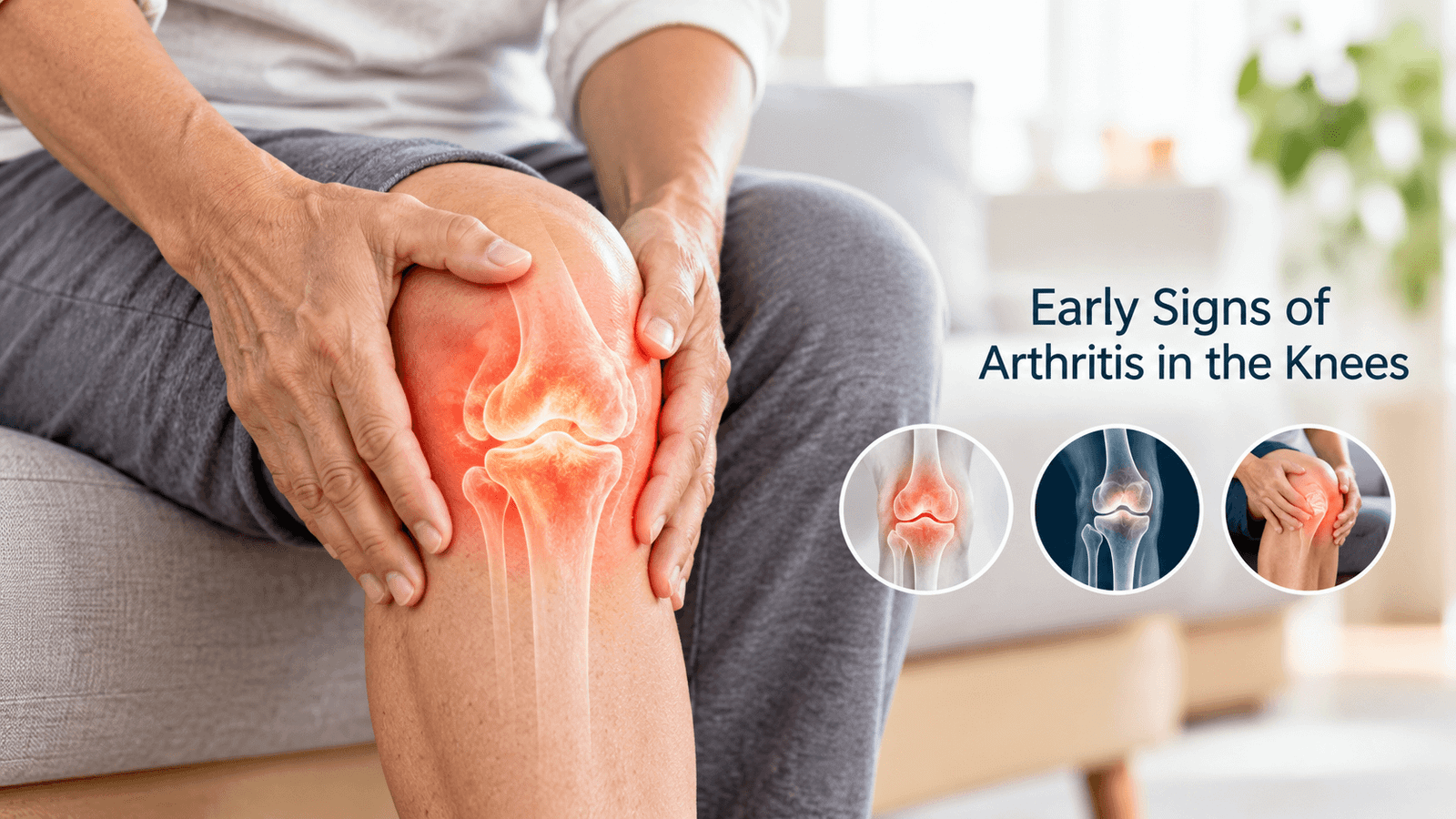
Your knee feels stiff when you stand up after a long meeting. Stairs have started to bother you, or you hear a creak when you squat to pick something up. It settles within the hour, so you forget about it until next week.
Many people put this down to getting older. Sometimes that is all it is. But a repeating pattern like this can also be one of the early signs of arthritis in the knees, and noticing it early gives you more options for keeping your knees working well.
This guide covers the early signs of knee arthritis, why they are easy to miss, how to tell osteoarthritis from rheumatoid arthritis, the red flags that should not wait, and what you can start doing today. It also explains when more advanced options such as Knee Replacement come into the picture. A separate section covers squatting and sitting on the floor, because those are everyday habits in many Indian homes and the research on them is more mixed than most articles admit.
What Are the Early Signs of Arthritis in the Knees?
The early signs are usually pain that builds with activity and eases with rest, stiffness after sitting or on waking that settles once you start moving, mild swelling, a grating or creaking feeling, tenderness around the joint, and trouble bending or straightening the knee fully. A few occasional noises alone are not a reason to worry. A pattern that repeats for several weeks, or that gets in the way of daily tasks, is worth checking with a doctor. A hot, red, swollen knee, fever or sudden severe pain needs prompt medical attention.
Key Takeaways
- Most arthritis in the knee is osteoarthritis (OA), where cartilage and other joint tissues change over time.
- Early signs are often subtle and come and go, so the pattern matters more than any single symptom.
- Stiffness that eases within about 30 minutes points more toward OA. Longer morning stiffness, with swelling in both knees or other joints, deserves a rheumatology opinion.
- Hot, red, swollen joints, fever or sudden severe pain are red flags, not signs to wait out.
- Exercise, strengthening and weight management are first-line care for knee OA, and they work best when started early.
- If self-care does not help within about four to six weeks, see a doctor.
What “Arthritis in the Knee” Actually Means
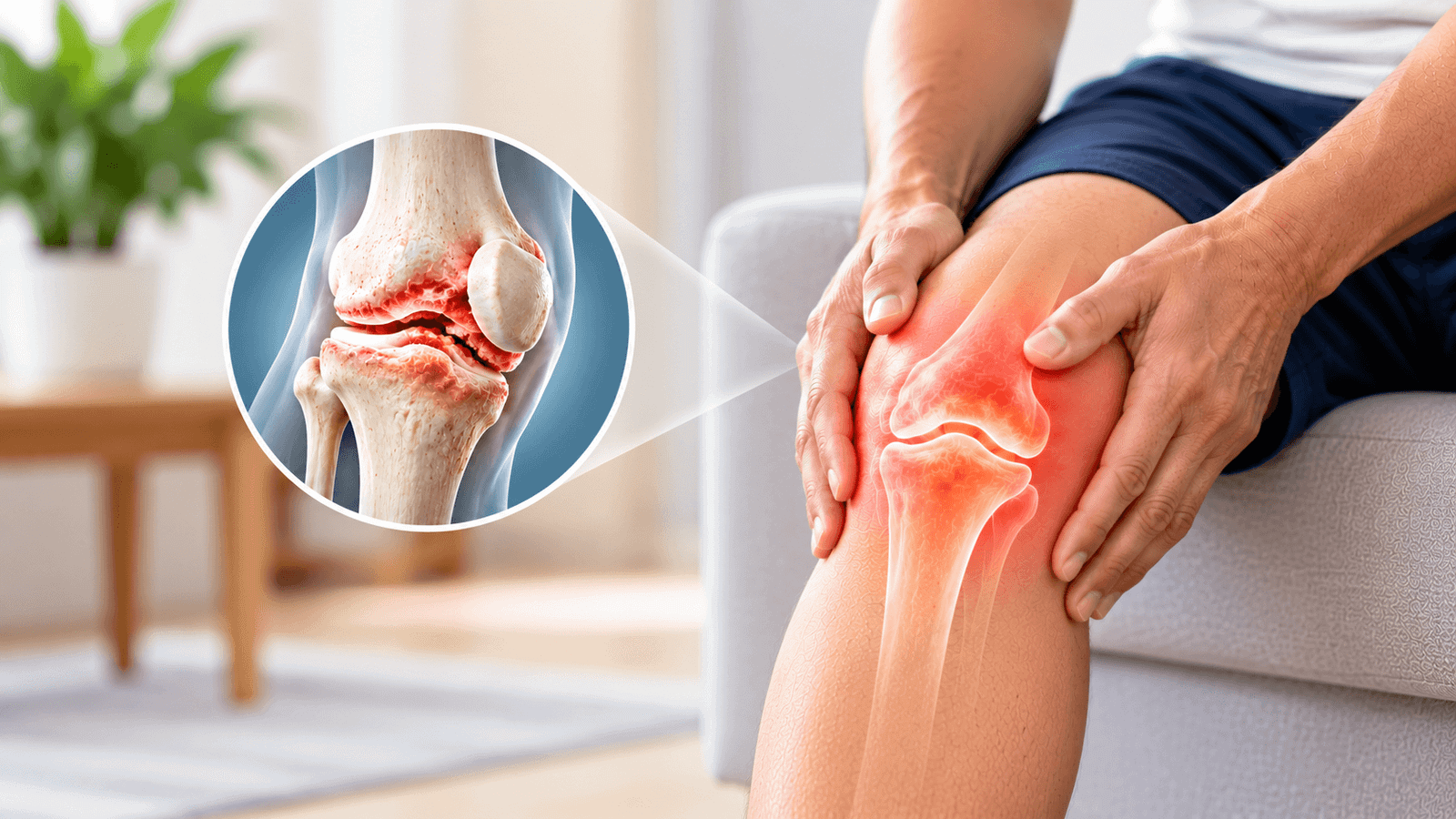
Arthritis is not one disease. It is a group of conditions that affect joints. In the knee, the most common type is osteoarthritis (OA). According to Mayo Clinic Sports Medicine, knee OA happens when the protective cartilage wears down while the bone around the joint grows or loses its smooth shape. Mayo Clinic’s overview adds that OA does not affect only cartilage. It also changes the bone and weakens the tissue bands that hold the joint together.
Other types exist, the best known being rheumatoid arthritis (RA), an autoimmune condition. Infections and inflammatory conditions can also affect the knee. That is why a proper diagnosis matters, and why this article spends time on the differences.
7 Early Signs of Knee Arthritis
No single one of the early signs of arthritis in the knees proves the diagnosis. What matters is whether a pattern shows up repeatedly over weeks.
1. Pain that builds with activity and eases with rest
Mayo Clinic Sports Medicine lists pain during or after movement as a common symptom. In OA, the ache typically grows the more you use the joint and settles when you rest. Examples are the dull ache after a long walk, or the knee that complains when you go down stairs. Early on, the pain may be occasional and easy to blame on a hard day.
2. Stiffness after sitting or when you first get up
Stiffness that is most noticeable in the morning or after a period of inactivity is another listed symptom. Think of standing up after a film, a train journey or a long day at a desk. In OA this stiffness usually eases within about 30 minutes of moving around, which is one of the clues that separates it from RA (see the comparison below).
3. Mild swelling or a puffy, tight-feeling knee
The knee may look slightly puffy or feel tight, especially after activity. Some people notice swelling behind the knee, called a Baker’s cyst, which is a common finding with knee OA. Swelling that appears suddenly, or comes with heat and redness, is a different story and is covered under red flags.
4. Creaking, grinding or crunching
Mayo Clinic Sports Medicine describes a grating sensation that you may hear or feel when you stand up, walk or climb stairs. Occasional, painless clicks are common in healthy knees and are often harmless. Noises become more meaningful when they are frequent, painful, or arrive together with stiffness, swelling or reduced movement.
5. Tenderness around the joint
The knee may feel tender when you press along its edges. You might notice it when kneeling, or when a seat belt, a pillow or the other leg presses against it at night.
6. Trouble fully bending or straightening the knee
Loss of flexibility is a recognised early change. In daily life it can look like difficulty squatting, sitting cross-legged on the floor, using an Indian-style toilet, or getting up from the floor after a meal or prayer. If you used to do these without thinking and now plan around them, that is worth noting.
7. A feeling of weakness or “giving way”
This is more often a later sign of moderate to advanced OA. It can also come from weak thigh muscles or from other knee injuries. Either way, a knee that gives way is a reason to see a doctor rather than push through, because it raises the risk of falls.
Why Early Knee Arthritis Is Easy to Miss
Several things make the early signs of arthritis in the knees hard to spot.
- Symptoms come and go. OA can flare up and then settle, so a good week can convince you the problem has gone.
- It is easy to blame age or a bad day. Early symptoms are mild enough to be dismissed.
- Pain and imaging do not always match. How much pain someone feels does not always line up with what an X-ray shows, so a normal-looking scan does not automatically rule out a problem.
Because of this, doctors rely on a combination of your history, a physical exam and, where needed, imaging. If you are unsure whether your symptoms count, write down what you notice for two to three weeks: when it hurts, how long stiffness lasts, and what makes it better or worse. That diary will make your appointment much more useful.
Is It Osteoarthritis or Rheumatoid Arthritis?
The two conditions can look similar on a bad day, but they have different causes and need different treatment. The Arthritis Foundation describes the main differences.
| Feature | Osteoarthritis (OA) | Rheumatoid arthritis (RA) |
|---|---|---|
| What it is | Wear and change in the joint | Autoimmune: the immune system attacks the joint lining |
| Stiffness after waking or rest | Eases within about 30 minutes of moving | Often lasts longer than 30 minutes |
| Pattern | Often one joint at a time; one knee may be worse | Tends to mirror itself on both sides of the body |
| Whole-body effects | Usually limited to the joints | Affects the whole body and can cause tiredness |
| How it is confirmed | History, exam and usually X-ray | Blood tests such as rheumatoid factor and anti-CCP antibodies, plus exam |
| Specialist | Primary care doctor first; orthopaedic specialist for advanced cases | Rheumatologist |
It is possible to have both at the same time. If you have long morning stiffness, swelling in both knees or in small joints such as the hands, or unexplained tiredness, ask for a rheumatology assessment instead of assuming it is wear and tear.
Who Is More Likely to Develop Knee Arthritis?
Mayo Clinic Sports Medicine lists these risk factors for knee OA:
- Older age
- Female sex
- Obesity
- A previous knee injury, such as an ACL or meniscus injury
- Jobs or sports that put high stress on the knees
- Family history and genetics
- Abnormal joint alignment
Mayo’s overview also notes that even an old injury that seemed to heal can raise risk later. Having risk factors does not mean you will develop arthritis, and having none does not guarantee you won’t.
Squatting, Sitting Cross-Legged and Indian Toilets: What the Research Says
Many Indian articles state that squatting and sitting cross-legged cause knee arthritis. The evidence is not that clear, and it is worth knowing what the studies actually found.
- A cross-sectional study of 135 knee OA patients at hospitals in Tamil Nadu, published in the National Journal of Medical Research, found that patients commonly squatted or sat cross-legged during tasks such as cooking, sweeping and mopping, and that people using Indian-style toilets were more commonly affected. Most patients were women, and the most common age group was 61 to 70. This kind of study describes patterns. It cannot show that these positions cause arthritis.
- A case-control study of 450 people in South India, summarised by Medical Dialogues, compared people with and without anterior knee pain, the kind of pain felt at the front of the knee. It found no association with cross-legged sitting or squatting. That study looked at kneecap pain, not osteoarthritis, so the two sets of findings are not directly comparable.
What does this mean for you? The research does not prove that these habits cause arthritis, and it does not prove they are safe for every knee. A sensible approach is to treat them as a signal. If squatting or floor sitting is starting to hurt, feel stiff or lock up, that is useful information to share with your doctor. NHS patient leaflets list kneeling, squatting, running and stairs among the activities that commonly aggravate symptoms. A physiotherapist can suggest practical changes, such as a raised seat or a different way of getting down to the floor, without taking away what you love doing.
Red Flags: When Not to Wait
Get medical help promptly if you have:
- A knee that is hot, red and swollen, especially if you feel generally unwell or have a fever
- Sudden onset of severe joint pain, rather than a slow build over months
- A significant injury, or trouble putting weight on the knee
- A knee that repeatedly gives way
- Symptoms in both knees plus long morning stiffness, small-joint swelling or unexplained tiredness
- Pain or stiffness that has not improved after about four to six weeks of self-care
Sudden symptoms with fever or severe pain can point to inflammatory or infectious arthritis, which is not the same as OA and needs urgent attention.
How Doctors Diagnose Knee Arthritis
According to Mayo Clinic Sports Medicine, diagnosis starts with a careful history and physical exam. Imaging is often recommended, starting with plain X-rays, and sometimes an MRI is used for a closer look. Occasionally, blood tests or joint fluid analysis are used to rule out inflammatory or infectious forms of arthritis.
Expect questions such as:
- When did the symptoms start, and how have they changed?
- How long does morning or after-rest stiffness last?
- Is one knee worse than the other, or are both affected?
- What activities make it better or worse?
- Have you ever injured the knee?
A doctor may also watch you walk and bend the knee. Bring your symptom diary and a list of any medicines or supplements you take.
What You Can Do Now
If you recognise the early signs of arthritis in the knees and no red flags apply, there is a lot you can start doing. These steps support, but do not replace, a doctor’s assessment.
Keep the knee moving
The 2019 ACR guideline, from the American College of Rheumatology and Arthritis Foundation, strongly recommends exercise for knee OA. It notes that exercise could include walking, strengthening, neuromuscular training and aquatic exercise, with no one type ranked above the others. Tai chi is also strongly recommended, and yoga and balance exercises are conditionally recommended. If you do yoga, tell your instructor about your knee and ask a physiotherapist which poses to modify, particularly deep knee bends.
An NHS-based patient leaflet from Mersey Care suggests aiming for 150 minutes of moderate aerobic activity a week, such as cycling or fast walking, plus specific strengthening exercises. It advises seeking further help if there is no improvement within four to six weeks.
Look after your weight
The same guideline strongly recommends weight loss for people with knee OA who are overweight or obese. A summary in American Family Physician notes that even a 5% weight loss brings a notable improvement in knee and hip pain. For someone weighing 80 kg, that is about 4 kg.
Pace yourself and ease flares
On a flare day, reduce the activities that clearly aggravate the knee rather than stopping movement altogether. Heat can help ease stiffness, and ice can help when the knee feels inflamed. Check with your doctor or pharmacist before taking any pain medicine or using any gel or cream, as the right choice depends on your health and other medicines.
Be cautious about supplements
The American College of Rheumatology and Arthritis Foundation guideline advises against glucosamine, alone or combined with chondroitin, because studies without industry funding showed no improvement for knee and hip OA. If you are considering any supplement, discuss it with your doctor first.
When to See a Specialist and What Treatment Can Include
Start with a general or primary care doctor. According to the Arthritis Foundation, they may refer you to an orthopaedic specialist for advanced OA, or to a rheumatologist if an autoimmune type is suspected.
Mayo Clinic notes that OA symptoms can usually be managed, although the joint damage itself cannot be reversed. Early diagnosis and treatment can help control symptoms, maintain movement and slow progression. Depending on your case, your care team may combine:
- Physiotherapy and a structured exercise plan
- Weight management and activity changes
- Walking aids such as a cane, or a knee brace in suitable cases
- Topical or oral pain relief, as advised by your doctor
- Steroid injections for flare-ups, which give short-term relief for some people
- Surgery, including knee replacement, when pain limits activity and quality of life despite other treatment
Mayo Clinic experts note that many people live with knee OA without ever needing surgery because non-surgical treatment works well for them, though it does not work for everyone. If surgery is suggested, getting a free second opinion can help you compare options before deciding. You can also browse hospitals to see where treatment is available.
Frequently Asked Questions
Is knee cracking a sign of arthritis?
Not necessarily. Occasional, painless clicking or popping is common in healthy knees. Cracking is more worth attention when it happens often, hurts, or comes with swelling, stiffness or trouble bending the knee. In that case it can be a sign of cartilage or joint changes. If you are unsure, note how often it happens and mention it to your doctor.
Can knee arthritis start in your 30s or 40s?
It can, particularly after a knee injury, with certain jobs or sports that stress the knees, or with a family history. Osteoarthritis becomes more common with age, but age is not the only factor. Inflammatory types such as rheumatoid arthritis can also begin earlier. If you have persistent knee symptoms at any age, it is reasonable to get them checked.
Will early knee arthritis show up on an X-ray?
Not always. X-rays mainly show bone changes and joint space, so very early joint changes may not be obvious. Pain also does not always match what the scan shows. Doctors usually combine your symptoms, an examination and imaging, and may order an MRI if more detail is needed. A normal X-ray with ongoing symptoms is still worth discussing.
Does arthritis pain come and go?
Often, yes. In many people knee OA symptoms flare and then settle, and over months or years they tend to become more frequent. A good week does not mean the problem has gone away. If you notice a repeating pattern, tracking it in a diary will help your doctor see the trend.
Can early arthritis be reversed?
The cartilage and joint changes of osteoarthritis cannot be reversed, according to Mayo Clinic. But symptoms can usually be managed, and early diagnosis and treatment can help maintain movement and slow progression. Exercise, weight management and the right support often make a real difference to how the knee feels and works.
Is walking good or bad for knee arthritis?
For most people, walking and other regular exercise help. Guidelines recommend exercise as a first-line treatment for knee OA, and walking is one of the options. If walking makes the pain clearly worse, try shorter, more frequent walks on flat ground, and ask a physiotherapist to tailor an exercise plan for you.
Should I stop squatting or sitting cross-legged?
There is no solid proof that these positions cause arthritis, but if they hurt or your knee feels stiff or catches, listen to that signal. Don’t stop moving altogether. A physiotherapist can suggest ways to modify positions, such as using a raised seat, so you can keep doing daily tasks comfortably.
Which doctor should I see first?
A general or primary care doctor is a sensible first step. They can examine the knee, order tests and refer you to an orthopaedic specialist if needed. If features such as long morning stiffness, swelling in both knees or small joints, or tiredness suggest rheumatoid arthritis, you may be referred to a rheumatologist.
How do I know it is arthritis and not a ligament or meniscus injury?
You cannot tell reliably at home. Injuries such as a meniscus or ligament tear often follow a specific twist or fall and can cause locking or giving way, while arthritis usually builds over time. Symptoms can overlap, and the two can coexist. An examination, and sometimes imaging, is the way to find out.
Do glucosamine and similar supplements work?
The American College of Rheumatology and Arthritis Foundation guideline advises against glucosamine, alone or with chondroitin, for knee and hip OA, because studies without industry funding showed no benefit. Some people feel better taking them, but the evidence does not support routine use. Talk to your doctor before starting any supplement, especially if you take other medicines.
Conclusion: Notice the Pattern, Move Early, Get It Checked
The early signs of arthritis in the knees are easy to explain away: a stiff start, an ache after a walk, a creak on the stairs. The useful question is whether a pattern keeps repeating. If it does, or if your knee is limiting what you want to do, get it assessed, because exercise, weight management and the right support work best when they begin early.
If you want a specialist opinion, Azzocare offers a free medical opinion and cost estimate from specialists, usually within 48 hours, plus help with the medical visa and travel for international patients. You can book a free consultation on Azzocare or read about medical travel to India.
This article is for informational purposes only and is not a diagnosis. Always consult a qualified healthcare professional for medical advice.
Sources
- Mayo Clinic Sports Medicine: knee arthritis
- Mayo Clinic: osteoarthritis, symptoms and causes
- Arthritis Foundation: differences between rheumatoid arthritis and osteoarthritis
- 2019 ACR/Arthritis Foundation guideline for osteoarthritis of the hand, hip and knee
- American Family Physician: updated osteoarthritis management guidelines
- Mersey Care NHS: knee osteoarthritis self-management
- National Journal of Medical Research: variables associated with knee osteoarthritis in Tamil Nadu
- Medical Dialogues: cross-legged sitting, squatting and anterior knee pain study