
A small lump found in the shower. Skin on the breast that looks like orange peel. A nipple that has started to turn inward. For many women, the first sign that something has changed is easy to dismiss, and most of the time it turns out to be harmless. But the question “what are the symptoms of breast cancer in female” is worth asking before a change appears, because the earlier a cancer is found, the more options a woman usually has.
This guide explains the first sign most people notice, 12 signs and 5 warning signs to know, hidden signs that are easy to miss, what the changes look like, and signs in young women. It also covers what is known about the causes of breast cancer, how to lower your risk, how screening works, and when to see a doctor.
Most breast changes are not cancer. But any new or lasting change should be checked, and nothing here can replace an examination.
What Are the Symptoms of Breast Cancer in Female?
The most common sign is a new lump or thickened area in the breast or underarm. Other signs include swelling of all or part of the breast, skin dimpling or redness, a nipple that turns inward or leaks fluid that is not breast milk, nipple or breast pain, and swollen lymph nodes under the arm. Many early breast cancers cause no symptoms at all and are found by screening mammograms. Most breast changes have harmless causes such as cysts or infection, but any new or persistent change should be checked by a doctor.
Key Takeaways
- A new lump is the best-known sign, but breast cancer can also show up as swelling, skin changes, nipple changes or an armpit lump.
- Many breast cancers cause no symptoms early, which is why screening matters.
- Most breast lumps and changes are not cancer, but you can’t tell by touch. They need to be checked.
- The exact cause of breast cancer is unknown. Age, family history, inherited gene changes, hormones and lifestyle all play a part.
- There is no guaranteed way to prevent breast cancer, but healthy weight, activity, less alcohol and breastfeeding can lower risk.
- If you notice any new breast change, see a doctor instead of waiting to see if it goes away.
What Is Usually the First Sign of Breast Cancer?
For many women, the first sign is a new lump or mass in the breast that they or their doctor can feel. According to breastcancer.org, which summarises American Cancer Society (ACS) guidance, a lump that is painless, hard and has uneven edges is more likely to be cancer. But cancers can also be tender, soft and rounded, so you can’t rule anything out by how a lump feels.
The first sign is not always a lump:
- Inflammatory breast cancer, a rare type that tends to grow quickly, often starts with pain and tenderness, along with redness and dimpling of the breast skin.
- Paget disease of the nipple, another rare form, can cause pain, burning and irritation of the nipple as early symptoms.
- Some cancers cause no symptoms, and an abnormal area first appears on a screening mammogram.
So the honest answer is that the first sign varies. That is why knowing what is normal for your own breasts, and having screening when it is due, both matter.
12 Signs of Breast Cancer Revealed
These are the changes that breast health organisations most often list. Having one of them does not mean you have cancer, because infections, cysts and other conditions can cause the same changes. They do mean it is time to be checked.
Early symptoms of breast cancer in women
- A new lump or mass in the breast. It may feel hard or soft, round or irregular, painless or tender.
- A lump or swelling in the armpit. Breast cancer can spread to lymph nodes under the arm, and the swelling can appear before a lump is felt in the breast itself.
- Swelling of all or part of the breast, even when no distinct lump can be felt.
- A change in the size or shape of the breast, such as one breast becoming larger or lower than the other.
- Skin dimpling or puckering. The skin may look like the peel of an orange.
- Skin that feels thicker, or a ridge of thickened tissue under the skin.
Other signs and symptoms of breast cancer in women
- Redness, scaliness or flaking of the skin of the breast or nipple.
- A nipple that turns inward (retraction or inversion). This can also happen with age, breastfeeding, injury or infection, so a new change is what matters.
- Nipple discharge that is not breast milk, particularly if it is clear or bloody.
- Nipple or breast pain. Pain is not a common early symptom, but a tumour can cause it, and pain that gets worse for no clear reason deserves a check.
- Swollen lymph nodes near the collarbone.
- A rash or sore on the breast or nipple that does not heal.
The 5 Warning Signs of Breast Cancer to Act on First
If you want a shorter list to remember, these five need attention first:
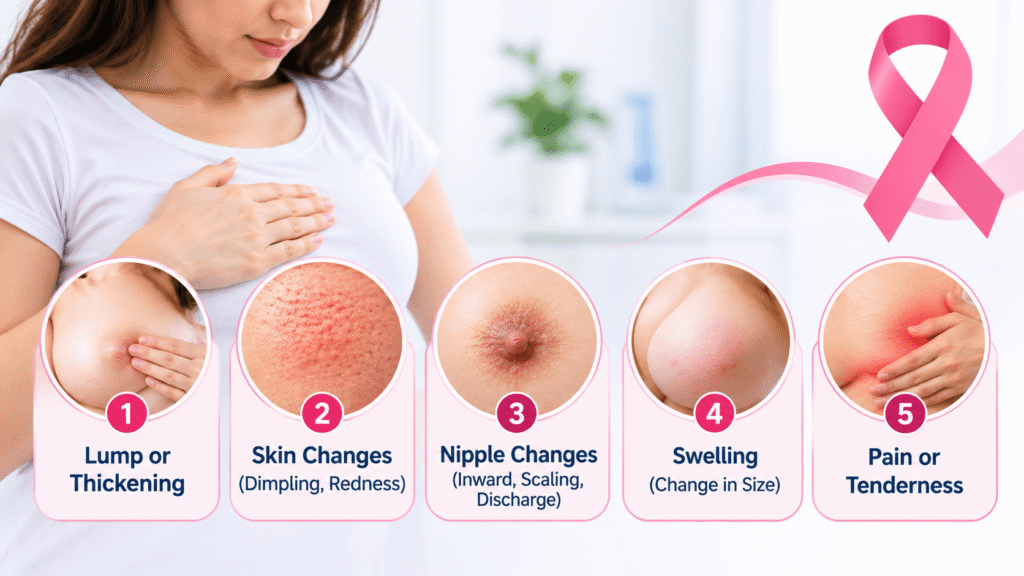
- A new lump or thickened area in the breast or armpit
- Skin changes, such as dimpling, redness or thickening
- Nipple changes, such as turning inward, scaling or discharge
- Swelling, or a change in the size or shape of a breast
- Pain or tenderness that is new, one-sided and persistent
The ACS notes that some changes, such as redness or swelling, can be caused by an infection called mastitis. If symptoms don’t improve after a week or so, get checked again, because inflammatory breast cancer can look a lot like a breast infection.
Hidden Signs of Breast Cancer That Are Easy to Miss
Some signs don’t look like what most people expect:
- A lump in the armpit before any breast lump. Cancer can spread to lymph nodes under the arm or around the collarbone before the tumour in the breast is large enough to feel.
- Scaly, itchy or burning skin on the nipple. It is easy to mistake for eczema or irritation, but it can be Paget disease of the nipple.
- A breast that looks swollen, red or thickened with no lump. This can happen in inflammatory breast cancer and may look like an infection.
- One breast that feels different from the other. Mayo Clinic advises having any new change evaluated, especially if one breast feels different.
- No symptoms at all. Many cancers are found only on a screening mammogram.
Early Signs of Breast Cancer: What the Changes Look Like
People often search for “early signs of breast cancer pictures.” We have not included clinical photographs here, because the same change can look very different on different skin tones, and a picture cannot tell you whether a change is cancer. These descriptions explain what to look for. If you want images, look for medically reviewed ones from a cancer charity or hospital, and use them for awareness, not self-diagnosis.
| What you may notice | How to describe it to your doctor |
|---|---|
| Skin with a dimpled, pitted texture like orange peel | “The skin on my breast looks puckered or pitted” |
| A nipple that has turned inward or flattened against the breast | “My nipple has changed position recently” |
| Red, dry, flaking or thickened skin on the nipple or breast | “There is a rash or scaly patch that is not clearing” |
| One breast looking larger, lower or differently shaped | “One breast has changed size or shape” |
| Clear or bloody fluid from the nipple | “There is discharge, and I am not pregnant or breastfeeding” |
| A lump or swelling under the arm or near the collarbone | “I can feel a lump in my armpit” |
Look at your breasts in good light and notice changes in shape, skin and nipple. Redness can be harder to see on darker skin, so also pay attention to thickness, warmth and texture.
Signs of Breast Cancer in Young Women
The signs in younger women are the same as in older women: a lump, skin changes, nipple changes or an armpit lump. What differs is how likely people are to suspect cancer.
- It is less common, but it happens. An Australian health service notes that around 5% of breast cancer cases are in women under 40. Reports from some countries suggest a larger share. For example, one Indian healthcare provider reported that over 25% of the breast cancer diagnoses in its screening data were in women under 40, with a median age of 53 compared with 62 in the US and UK. That is one provider’s data, not a national statistic.
- Routine screening usually starts later. Mammograms are generally recommended from the 40s for women at average risk, so younger women often rely on noticing changes and on a clinical breast exam. Dense breasts, which are more common in younger women, can also make tumours harder to see on a mammogram, according to the CDC.
- “Too young” is not a reason to wait. Doctors quoted in a Business Standard report say young women often dismiss lumps as harmless and that younger patients more often have faster-growing tumour types, which is another reason to get a new lump checked.
- Family history matters. If breast or ovarian cancer runs in your family, especially at a young age, ask your doctor about earlier screening and genetic counselling.
Breast changes during pregnancy and breastfeeding are common and usually harmless, but a lump that persists should still be checked.
Breast Cancer Causes: What We Know and What We Don’t
The exact cause of breast cancer is still unknown. What research has found are risk factors, things that raise the chance of developing the disease. Having a risk factor does not mean you will get breast cancer, and the CDC notes that most women with some risk factors do not get it, while some women with none do.
| Risk factors you can’t change | Risk factors you may be able to change |
|---|---|
| Getting older. Most breast cancers are diagnosed after age 50 | Not being physically active |
| A family history of breast or ovarian cancer | Being overweight or having obesity after menopause |
| Inherited changes in genes such as BRCA1 and BRCA2 | Drinking alcohol. Risk goes up with the amount |
| A personal history of breast cancer, or certain non-cancerous breast conditions | Taking combined estrogen and progesterone hormone therapy for more than five years |
| Dense breasts | Some birth control pills, which slightly raise risk |
| Starting periods before age 12, or menopause after age 55 | A first pregnancy after 30, never having a full-term pregnancy, or not breastfeeding |
| Radiation therapy to the chest before age 30 | Smoking, and possibly some chemical exposures or night-shift work |
What are the main causes of breast cancer in women?
There is no single cause. The main contributors researchers point to fall into four groups:
- Age. Risk rises as women get older.
- Genes and family history. Inherited changes in genes such as BRCA1 and BRCA2 raise risk sharply, but they account for only a small share of breast cancers. Sources put inherited causes at around 5% or less.
- Hormones and reproductive history. More lifetime exposure to estrogen, through early periods, late menopause or hormone therapy, is linked to higher risk.
- Lifestyle. Alcohol, excess weight after menopause and inactivity all raise risk.
How to Avoid Breast Cancer: Ways to Lower Your Risk
The World Cancer Research Fund says there is no guaranteed way to prevent breast cancer, but you can take steps to lower your risk. These are the main ones, based on CDC, Mayo Clinic and WCRF guidance:
- Keep a healthy weight. Being a healthy weight and avoiding weight gain in adulthood can lower the risk of breast cancer after menopause.
- Be physically active. Mayo Clinic suggests at least 150 minutes a week of moderate aerobic activity, or 75 minutes of vigorous activity, plus strength training at least twice a week. WCRF notes that all types of activity can lower risk after menopause.
- Limit alcohol, or avoid it. WCRF says there is no safe level for breast cancer. Mayo Clinic advises no more than one drink a day if you do drink, and notes that even small amounts raise risk.
- Breastfeed if you can. There is strong evidence that breastfeeding lowers breast cancer risk, and the longer a woman breastfeeds the greater the effect.
- Review hormone therapy and the pill with your doctor. Combined hormone therapy after menopause may raise risk. Hormonal contraception raises risk slightly, and the risk falls after you stop.
- Eat well. Mayo Clinic notes that women who eat a Mediterranean diet with extra-virgin olive oil and mixed nuts might have a lower risk.
- If you have a strong family history, talk to your doctor about genetic counselling and other ways to lower risk, such as medicines that block or reduce estrogen, or surgery.
Screening does not prevent breast cancer, but it can find it earlier.
Screening and Breast Awareness
A screening mammogram looks for breast cancer in women who have no symptoms. Mayo Clinic notes that most mammogram guidelines recommend starting in the 40s and repeating every year or two, and starting sooner if you have a family history or other risk factors. The ACS recommends that women at average risk have a yearly mammogram from 45 to 54, with the option to start at 40 to 44. Recommendations differ between countries and organisations, so ask your doctor what suits you. You can also ask about a general health checkup.
On self-exams, views differ. The ACS does not recommend routine breast self-exams for women at average risk, but says there is value in learning what is normal for your breasts and noticing changes. The key point is the same either way: know what is normal for you, and report changes promptly.
When to See a Doctor and What Happens Next
See a doctor about any new lump or breast change, especially if it is new, persistent, or if one breast feels different from the other. Start with your family doctor or a gynaecologist, who can refer you to a breast specialist or oncology specialists if needed. Seek care promptly if a breast becomes red, swollen and tender quickly, since inflammatory breast cancer can look like an infection and needs fast treatment.
According to Mayo Clinic and the CDC, diagnosis usually follows these steps:
- A clinical breast exam. The doctor checks the breasts, collarbones and armpits and asks about symptoms and medical history.
- Imaging. A diagnostic mammogram looks more closely at a concern. An ultrasound can show whether a lump is solid or a fluid-filled cyst. A breast MRI is used less often, for example when the breasts are dense or the diagnosis is in question.
- A biopsy. A tissue sample is removed and examined under a microscope. A biopsy is what confirms or rules out cancer.
- Staging tests, if cancer is found. These check whether it has spread within the breast or elsewhere.
An abnormal result does not mean you have cancer. Many lumps turn out to be cysts or other benign conditions. You can browse hospitals to find a centre for an assessment.
If Breast Cancer Is Diagnosed
Treatment depends on the type and stage of the cancer, its characteristics, and your own preferences. The biopsy helps identify these characteristics. Treatment may include one or more of the following:
- Surgery to remove the tumour or the breast
- Radiation therapy
- Chemotherapy
- Hormone therapy for hormone-sensitive cancers
- Targeted therapy for cancers with certain features
Many women also discuss breast reconstruction with a plastic surgeon. A free second opinion can help you review a treatment plan before you decide.
Frequently Asked Questions
Is breast pain a sign of breast cancer?
Pain is not a common early symptom of breast cancer, and breast pain usually has other causes. But a tumour can cause pain if it presses on nearby tissue, and pain is often an early symptom of inflammatory breast cancer. See a doctor if pain is persistent, localised to one area, or getting worse without a clear reason.
Can breast cancer have no symptoms?
Yes. Many breast cancers cause no obvious symptoms, especially early on, and are found on a screening mammogram. That is why screening is recommended even when you feel well.
What does a breast cancer lump feel like?
A lump that is hard, painless and has uneven edges is more likely to be cancer, but cancerous lumps can also be soft, round or tender. You cannot tell by touch whether a lump is cancer, so any new lump should be checked.
Can you have breast cancer without a lump?
Yes. Breast cancer can cause swelling of the breast without a distinct lump, skin changes such as dimpling or redness, nipple changes, or a swollen lymph node under the arm. Inflammatory breast cancer often shows up this way.
Can young women get breast cancer?
Yes. It is less common under 40, with one estimate putting it at around 5% of cases, but it does happen. Young women should report any lump or breast change, and not assume they are too young.
Are breast self-exams recommended?
Views differ. The American Cancer Society does not recommend routine self-exams for women at average risk but says it is valuable to know what is normal for your breasts and to report changes. Ask your doctor what is right for you.
Do all breast lumps mean cancer?
No. Most breast lumps are not cancer. Cysts, benign growths and infections are common causes. Because you can’t tell by feel alone, a new lump still needs to be evaluated.
When should I get a mammogram?
It depends on your age and risk. The ACS recommends yearly mammograms from 45 to 54 for women at average risk, with the option to start at 40 to 44. If you have a family history or other risk factors, your doctor may suggest starting earlier.
Can breast cancer be prevented completely?
No. There is no guaranteed way to prevent breast cancer. You can lower your risk by keeping a healthy weight, being active, limiting alcohol and breastfeeding if you can, and screening helps find cancer earlier.
Which doctor should I see for a breast lump?
Start with your family doctor or a gynaecologist. They can examine you and arrange imaging, and refer you to a breast specialist or oncologist if needed.
Conclusion: Know Your Normal and Get Changes Checked
So, what are the symptoms of breast cancer in female? Most often a new lump, but also swelling, skin changes, nipple changes, pain or a lump in the armpit, and sometimes nothing at all. Most breast changes turn out not to be cancer, but the only way to know is to have them checked.
Know what is normal for your breasts, keep up with screening when it is due, and don’t wait to see whether a new change goes away. If you want a specialist opinion, Azzocare offers a free medical opinion and cost estimate from specialists, usually within 48 hours, plus help with medical visas and travel for international patients. You can book a free consultation on Azzocare or read about medical travel to India.
This article is for informational purposes only. Always consult a qualified healthcare professional for medical advice.
Sources
- breastcancer.org: signs and symptoms of breast cancer
- American Cancer Society: breast cancer symptoms, what you need to know
- CDC: breast cancer risk factors
- CDC: how to reduce your risk of breast cancer
- CDC: diagnosing breast cancer
- Mayo Clinic: breast cancer diagnosis and treatment
- Mayo Clinic Health System: breast cancer prevention
- World Cancer Research Fund: preventing breast cancer
- HealthyWA: what are the risk factors for breast cancer?
- ScotPHO: breast cancer risk factors
- BioVoice (Apollo data): 25% of breast cancer incidence observed in women under 40 in India
- Business Standard: why more young women are being diagnosed with breast cancer